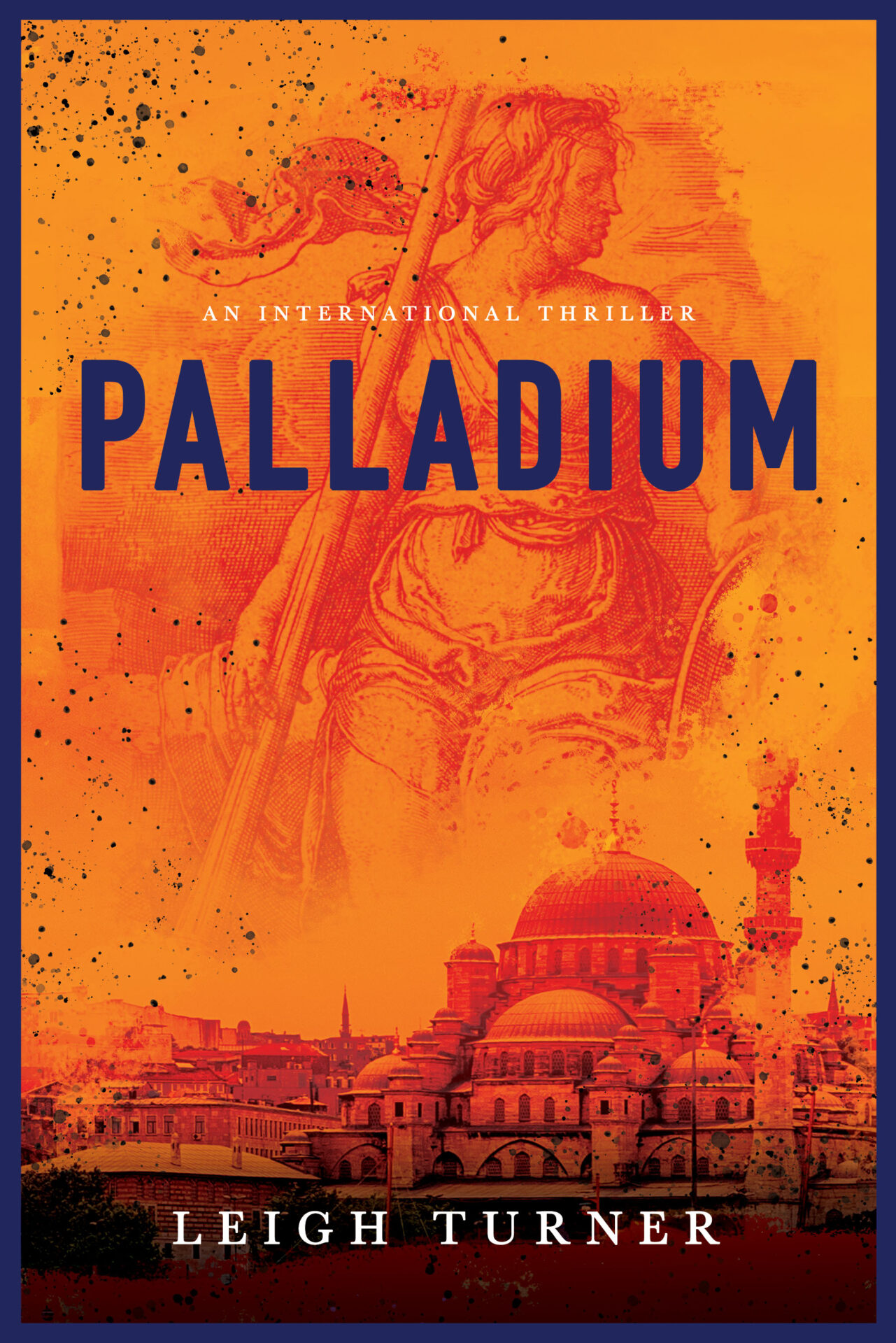
You can read the first three chapters of PALLADIUM below.
Chapter 1: 1453
THE JANISSARY WARRIOR, Yusuf Ali-Bey, had triumphed in countless battles. He and his dear friend Hasan had slain numberless foes.
He had never faced a challenge such as this.
Before dawn, Yusuf and his loyal fighters must sacrifice themselves to achieve a task so secret that only he knew their true goal.
If Yusuf succeeded, Hasan would lead a triumphant dawn assault. Constantinople, great capital of the Christians, would fall.
Failure would mean death for Hasan and his men.
In the darkness, Yusuf gazed at his goal. His hand went to the nazar around his neck, beneath the heavy chain mail.
Every attack up to now had failed. Rotting Ottoman corpses blackened the towering walls of Byzantium. Torches on the battlements and guttering flames amidst the rubble cast shadows over the myriad dead.
Yusuf flinched as a hell-bellow of thunder roared behind him. Sultan Mehmet’s cannon, the Basilica, had spoken. The giant iron ball smashed into the walls, pulverising masonry, bodies, and the blackened hulks of burned-out war machines. Screams rang out from the defenders on the ramparts.
They were right to be afraid.
From the parapet, defenders swarmed down ropes and ladders with wooden beams and barrels of earth to repair the damage wrought by the Basilica.
Yusuf surveyed the chaos, every sense attuned to the battlefield.
Drumbeats rang out and a cacophony of pipes and trumpets erupted. Irregular bashi-bazouk forces, Christian slaves and mercenaries from Albania, Hungary, Germany and even Greece, in the service of Sultan Mehmet, rushed at the walls with siege ladders and grappling hooks, yelling their battle cries.
Now. Yusuf waved his men forward, cloaks masking their captured Venetian armour.
Chapter 2: Present day
AS JOHN BROWN stood on the balcony and looked down at the Bosphorus, he found himself thinking about his estranged lover, Elif. Last night, they’d tried a new start. Instead, everything had ended. Today, she was somewhere across the water, excavating relics beneath the Old City.
“Stop daydreaming, John,” Orhan Mutlu said. “You’ve got work to do.” The burly Turkish intelligence officer stood shoulder to shoulder with Brown on the balcony. Below, shrieking gulls skimmed white-capped waves. Across the Bosphorus on the European side, the morning sun painted pink the domes, minarets and towers of the Old City of Istanbul. A huge military vessel, flanked by two destroyers bristling with weaponry, steamed past the Golden Horn.
“Look at that aircraft carrier,” Orhan said. “The Gerald R. Ford. Outside powers always try to dominate Turkey. But we’re fighting back. As you know, to your cost.”
“I don’t want to dominate your bloody sister.” The sun warmed Brown’s neck.
“A Turkish woman is a match for any man.”
“She and I were together. Now we’re not. End of story.” Brown wiped a trickle of sweat from his forehead. He pictured Elif on site in her shorts and baggy shirt, hair tangled, calves flecked with dust.
“Instead of wasting her time on you,” Orhan said, “she is racing to find the famous Palladium.”
“The Palladium’s a Greek myth. Elif told that US journalist, Misty Anderson, she’d be more likely to find Achilles down a catacomb, polishing his sword.”
“You imperialist powers think arguments are won by logic. In reality, strength decides everything.” Without warning, Orhan slapped Brown on the back. “Tonight, we’ll teach you a lesson you’ll never forget.”
Brown whirled round and seized the Turk’s wrist. “Don’t touch me.”
Orhan jerked back his arm. “Elif said you were crazy. I was only talking about the soccer.”
Inside the room, two managers faced a battery of TV cameras.
“We expect two thousand fans for tonight’s game against Beşiktaş,” the Liverpool boss said. “I trust the Turkish police will keep them safe.”
“Still no terrorist threats on your secret channels?” Orhan said to Brown. “Or are you keeping the best stuff for yourself, as usual? Excuse me.” He pulled out his phone.
“What is it?” Brown said.
“A message from Elif.” Orhan signalled to his deputy. “Call me if anything comes up. My sister needs me.”
“Let me see.” Brown tried to grab the phone, but the intelligence cop shook him off.
“Nothing frightens Elif,” Orhan said. “Something bad must have happened.”
Brown blocked the doorway, holding his limbs relaxed but ready. “I’ll ask nicely. If you want to leave, please show me the text.”
Orhan’s eyes narrowed. “You truly are a psycho.” He held up the screen.
Come quickly. Elif’s text was in Turkish. I am afraid.
Brown was acting as police liaison for tonight’s match. His boss, the Consul General, would give him hell if he went AWOL. But Elif was in trouble.
“I’m coming too.” He met Orhan’s gaze.
“I thought you had Liverpool supporters to look after? Anyhow, you’ve finished with Elif.”
“She needs help,” Brown said. “And I don’t trust you to protect her.”
Chapter 3: 1453
YUSUF LED HIS men through the night. All along the land-walls of Byzantium, from the Blachernae Palace to the north, past the Mesoteichion, down to the Golden Gate and the Marble Tower where stone ramparts plunged into the Sea of Marmara, tens of thousands of bashi-bazouks fought their way up mounds of rubble beneath the walls.
From the battlements, Genoese and Venetian archers rained arrows and crossbow bolts on the attackers. Catapults hurled jagged rocks into the massed ranks of the advancing troops. Yet still the bashi-bazouks trudged on up the ramp of broken stone, adding their bodies to those over which they climbed. As men fell, more rushed forward to fill their places, shields held over their heads.
Further back, out of range, massed the main force of the Sultan’s crack Janissary regiments, harbouring their strength for the dawn assault. Yusuf’s friend, Hasan, led them. A giant of a man, he loved to play satranç, the game also known as chess, with Yusuf. Hasan had sworn to win the Sultan’s prize for the first soldier to penetrate the stockade and plant the Ottoman colours within the city.
Yusuf prayed he would succeed.
Around the sea-walls too, the Sultan’s fleets harassed the defenders, firing cannon and landing troops to support the main assault.
But unless Yusuf achieved his goal, Hasan and the Janissaries would be massacred.
He lifted his arm, finger raised. One finger meant move ahead, in silence. A fist, stop. An arm thrown forward, all-out assault.
The eleven fighters in Yusuf’s team uttered no battle cries. Their feet and armour were wrapped in cloth, their bright Venetian blades greased and sheathed. They moved like wraiths through the shadows beneath the walls.
Yusuf led them north towards the assault.