

The Strait of Hormuz: thoughts on “Project Freedom”, its pausing, hints of an imminent deal to reopen the Strait, and what might happen next.
An impossible situation?
I don’t claim to be any kind of Iran or Gulf expert. But I do have experience of trying to make sense of what President Trump says about the Russia/Ukraine war (over 100 interviews in 2025), and have worked briefly on the Iran nuclear talks in Vienna (2016-17). As a couple of media channels asked me to opine on the Strait of Hormuz on 6 May, I did a bit of research, looking at publicly available news sources. The results are as follows: apologies for anything that’s wrong or out-of-date.
Let’s be clear: the situation is as clear as mud. We’ve had a welter of conflicting statements from the US and Iran over recent days. On 6 May, rumours swirled that the US side felt negotiations with Iran might soon settle the conflict. An early Iranian response was a statement from Ebrahim Rezaei of the Iranian Parliament’s national security and foreign policy commission, that US hopes for a deal were a “wish list” and that Iran “has its finger on the trigger and is ready”. Shortly after, the Iranian foreign ministry said the US proposal to finish the war was still being considered.
What was “Project Freedom” and was it working?
On Sunday, 3 May, the US announced “Project Freedom”. Its goal was to help guide through the Strait of Hormuz ships stranded in the Gulf since the start of the war on 28 February. Estimates of the number of those trapped vary, from around 1,000-2,000 ships stranded and around 20,000-22,500 seafarers. Conditions for these people are grim, stuck in limbo indefinitely in spartan conditions. The US announced it was devoting to “Project Freedom” vast resources, including guided missile destroyers, over 100 land- and sea-based aircraft, and 15,000 troops.
On Tuesday, 5 May, two days after announcing “Project Freedom”, President Trump announced that it had been paused. Even before the announcement, it wasn’t clear if the scheme was working. A trade body representing tanker owners said there was no co-ordination for the operation: captains and owners weren’t sure whether ships could safely pass the strait. Contradictory reports emerged: that US military ships had been hit by missiles; that cargo ships, or US Navy missile destroyers, had transited the straits; and that the US had attacked Iranian fast boats.
But one thing seemed pretty clear. Ship owners and captains could not be 100% confident that the strait was safe, and open. Given the need to protect crews and cargoes, and to satisfy insurance companies, the strait was, effectively, still closed.
“Project Freedom” paused
President Trump’s announcement of a pause in “Project Freedom” said “great progress has been made towards a complete and final agreement with representatives of Iran” and that the initiative “will be paused for a short period of time to see whether or not the agreement can be finalised and signed.”
This all sounds encouraging. But in the absence of visible negotiations between the US and Iran, it’s not clear who is talking to whom; what the prospects are of a deal; and what any deal might consist of. Remember, President Trump announced on 17 April that the Strait of Hormuz was “completely open and ready for business”. That proved illusory. Iranian state media, predictably, depicted the pausing of “Project Freedom” as an American retreat.
Strait of Hormuz: a glimmer of hope?
On Wednesday 6 May, the US news agency Axios reported, citing US sources, that the US and Iran were close to agreement on a 14-point plan that would include a moratorium on nuclear enrichment by Iran; the lifting of US sanctions; release of frozen Iranian assets; and both sides lifting restrictions on Strait of Hormuz. This apparently encouraging news set oil prices falling and buoyed stock markets. It’s worth reading the measured, thoughtful Axios analysis at the link. It appears detailed and addresses some of the key issues. These include an Iranian moratorium on uranium enrichment, removing existing highly-enriched (60% U-235) uranium from Iran, and an enhanced IAEA (International Atomic Energy Agency) inspection scheme to prevent cheating.
The Axios report also contains a key sentence: “In its current form, the MOU would declare an end to the war in the region and the start of a 30-day period of negotiations on a detailed agreement to open the strait, limit Iran’s nuclear program and lift U.S. sanctions.” This exposes a host of uncertainties:
- will the MOU be agreed, and, if so, will it remain unchanged?
- will the Strait of Hormuz be opened during the proposed 30-day period, or only at the end of it? Remember, keeping the Strait closed is Iran’s main source of leverage on the US (see below). If the Strait remains closed while discussions drag on, this could risk strengthening Iran’s position.
- reaching agreement on limiting Iran’s nuclear programme (or program) in just 30 days will not be straightforward: past agreements have taken years, and multiple meetings of experts, to agree.
- “lifting US sanctions” could mean all kinds of things – from lifting all US sanctions against Iran to some less comprehensive measure. The US has had a complex patchwork of sanctions in effect against Iran since the Iranian revolution and the diplomatic hostage-taking of 1979.
How the oil price reflects expectations of a deal
Some of the most brilliant brains (and AIs) in the world are trying to guess how oil prices will move in future. So the oil price reflects expectations of a deal. Before the Iran war started, the oil price was around $60-70 per barrel (Brent crude). Since then it has risen to over $100 a barrel, spiking higher and yo-yoing around as the prospects for an end to the Iran war have waxed or waned. On 6 May the oil price fell swiftly, to under $100 per barrel. But this remains very high, and challenging for the world economy. Reports suggest that even if the Strait of Hormuz opened tomorrow, existing shortages and production bottlenecks could leave prices high for months or longer.
Strait of Hormuz: who is the US negotiating with?
The US/Israeli strikes on Iran after 28 February decapitated the Iranian leadership. This makes it harder to work out who now represents Iran in any negotiations. Differing Iranian responses to developments on 6 May (see above) illustrate this. Many ordinary Iranians would no doubt be delighted for the fighting to stop.
Hardliners in Iran, including the Islamic Revolutionary Guard Corps (IRGC) may have other views. They may believe that spinning out the war will cause more harm to the US than to Iran:
- Iran’s economy was tottering even before 28 February. It’s in worse shape now. But the world economy is suffering from energy shortages caused by the closure of the Strait of Hormuz. Iranian hardliners may believe Iran can hold out longer than the rest of the world.
- the Gulf states and Saudi Arabia are desperate to see the war end. There are reports that Saudi Arabia was pressing to see “Project Freedom” paused.
- rising petrol (gas) prices in the US are problematic for President Trump with the mid-term elections approaching on 3 November. Prices breached $4.50/gallon for first time in four years this week.
In many conflicts, hardliners want wars to continue because they strengthen their position in society. The Iran war is no exception.

Gulf states such as the UAE are desperate to see the war end
Strait of Hormuz: what next?
None of this suggests a comprehensive peace deal is imminent. But let’s hope I’m completely wrong. The passage in my book “Lessons in Diplomacy” entitled “When to admit you’re wrong” lists a series of blunders. They include my certainty, in 1981, that German unity would never come about in my lifetime. None of us should feel too certain of our predictive powers, I write, especially about the future.
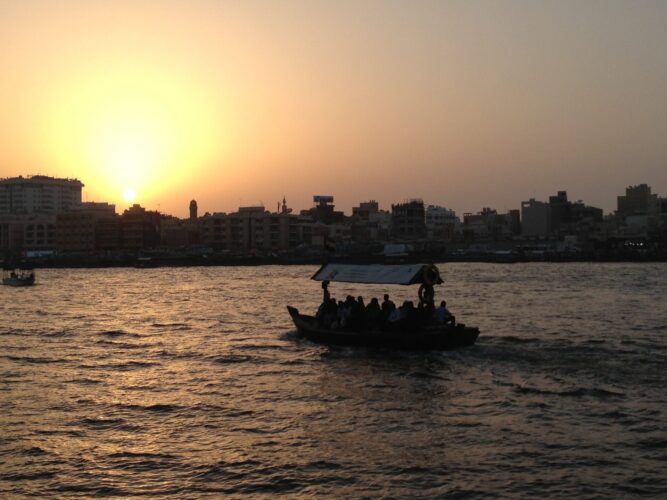
The pictures illustrating this piece are from Dubai.