“Never”, by master thriller-writer Ken Follett, starts slow but the last 20% is excellent as humanity careers towards self-annihilation. Plus: great Follett epigrams.
Ken Follett: master thriller-writer
I’ve been a big Follett fan since reading Pillars of the Earth back in 1989. Follett has written dozens of books: his Wikipedia entry makes him appear a polymath and all-round nice guy. Most have tens of thousands of Amazon reviews, nearly all positive. Follett has written several series of historical novels, plus around 23 stand-alone novels. Never came out in 2021.
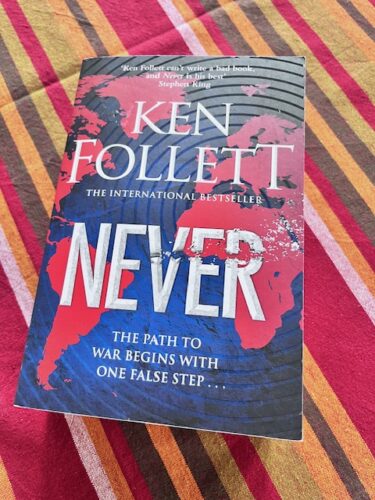
I like the blurb: “The path to war begins with one false step…”
Never by Ken Follett: dauntingly thick
Never is a great brick of a book. My paperback edition is around 817 pages. Such volume can put readers off. You can’t put it in your pocket to read on the bus.
As with all Follett books I’ve read, Never features well-drawn, believable characters. They range from US spies and water-deprived locals in Chad through senior Chinese Government figures to the (female) President of the United States, who – this being Follett – is going through her own personal crisis in her marriage.
In fact, every major character has a hinterland. The Chinese spy chief is married to a soap movie star. A US spy in N’djamena is in love with a handsome French colleague; even a mysterious traveller on a people-smuggling route lost his baby sister in a Beirut bombing. It’s rich, elegant stuff. But I wondered if we could have lost or shortened some of these threads to move the action of the first 75% of the book along more quickly and get pulses racing earlier.
A satisfying climax
This all changes in the final 25% of the book. Never has five sections. It begins with DEFCON 5 (“Lowest state of readiness” of the US armed forces), followed by DEFCON 4, DEFCON 3 etc. We reach DEFCON 3 (used on 9/11) only at page 600 of my 800-page edition – a bit late, arguably. But from there, tension rises as the threat of a nuclear war grows and we move into DEFCON 2, then DEFCON 1. There are some good twists involving events in Korea and within the Chinese ruling elites. Earlier threads, including those set in Africa, fade into the background.
Never by Ken Follett: epigrams
Ken Follett is a master of pithy observations and epigrams. Indeed, I was inspired to write this post in order to highlight a few. In an Africa section, one character observes:
- Sometimes, international politics was just like a Sicilian vendetta… People took revenge for what had been done to them, as if they did not know that their rivals were sure to take revenge for the revenge. As the tit-for-tat went on, escalation was inevitable: more rage, more vengeance, more violence.
Another muses:
- That was the weakness of dictators. They were so used to getting their own way that they did not expect the world outside their domain to refuse them anything.
The US president reflects on her loud-mouthed, chaotic opponent. It is possible Follett has someone in mind:
- Aggression was his default mode, and that was what his supporters liked. He pretended that no one could ever stand against America – forgetting Vietnam, Cuba, Nicaragua. [Comment: I would add Afghanistan, Iraq.] He talked tough and it made his fans feel big. But violent talk led to violent action in the world just as it did in the school playground. A fool was just a fool, but a fool in the White House was the most dangerous person in the world.
Later, she observes:
- Every catastrophe begins with a little problem that doesn’t get fixed.
Chang Kai, the Chinese master spy, reflects on power:
- As a young man he had tried to figure out who really had the power. Was it the president, the head of the army, or the members of the Politburo collectively? Or the American president, or the American media, or the billionaires? Gradually, he had realized that everyone was constrained. The American president was constrained by public opinion, and the Chinese president by the Communist Party. The billionaires had to make profits and the generals had to win battles. Power resided not in one locus but in an immensely complex network, a group of key people and institutions with no collective will, all pulling in different directions.
This strikes me as a fair summary.
Never by Ken Follett: worth a read
Stephen King says of Never: “Ken Follett can’t write a bad book, and Never is his best”. I wouldn’t go that far. But it’s a well-crafted thriller full of great characters, and builds to a powerful climax. Definitely worth a read.
What to do next
If you like thrillers, you may like to look at my earlier post Classic thrillers and where to find them.
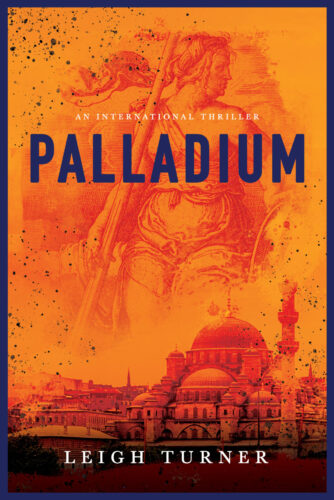
I’ve also written a couple of thrillers, including Blood Summit, set in Berlin, and Palladium, set in Istanbul. Some readers seem to like them, which is encouraging. I’d love to hear your recommendations.