“Salonica – City of Ghosts” is an eery, elegiac portrait of a city that – in many respects – had a completely different identity to modern Thessaloniki.
Mark Mazower: Salonica, City of Ghosts
When I was British Consul-General in Istanbul (2012-16), my Greek colleague lived around the corner. ‘You should visit Thessaloniki,’ he said. ‘Before you go, read this book.’
He presented me with a copy of Mark Mazower’s book “Salonica, City of Ghosts”, subtitled “Christians, Muslims and Jews 1430-1950”.

My copy of “Salonica, City of Ghosts”
Reading “Salonica, City of Ghosts”
Shamefully, I didn’t visit Thessaloniki until 2024. Before setting off, I dug out Salonica, City of Ghosts and read it.
It was a revelation. Mazower depicts a city that, for centuries, was one of the most diverse communities on earth. Founded in 315 BC, Salonica became a metropolis under the Roman Empire. It grew to become the second greatest city of the Byzantine Empire before being conquered by the Ottomans in 1430 (23 years before the conquest of Istanbul, described in my thriller Palladium). In 1478 the city’s population comprised around 60% Christians and 40% Muslims. When Spain expelled the Jews in 1492, the Ottomans encouraged them to settle in Salonica and by 1519, they made up around 54% of the population.
For much of the city’s history from the 1490s until 1943, Jews formed the largest ethnic group in Thessaloniki. Even in the 20th century, they were a tightly-knit group, who continued to speak Ladino (Judeo-Spanish). For long periods Salonica was one of the largest, or possibly the largest, Jewish-majority city in the world. Many other ethnic groups lived in the city, including Greeks, Albanians, Ukrainians and Arabs.
But today’s nationalities make little sense when applied to Salonica, as Mazower points out:
- ‘Turk’ was a term which made little or no sense when applied to a Muslim population which ranged, as a German visitor noted, from ‘the black of Ethiopia’ [in reality, slaves brought over from the Sudan and beyond], to fair-skinned Circassians, blue-eyed Albanians, and Hungarian, Prussian and Polish converts.
Rather, many people defined themselves by their religion.
Salonica and nationalism
Mazower’s account is a reminder that until the growth of nationalism in the 19thC, many people across Europe did not identify themselves with any particular country:
- To understand the forces of nationalism and their impact on the late nineteenth-century city we need above all to appreciate their novelty. Much time, money and effort was required by disciples of the new nationalist creeds to convert its inhabitants from their older, habitual ways of referring to themselves, and to turn nationalism itself from the obsession of a small, educated elite to a movement capable of galvanizing masses.
Although modern Greece declared its independence in 1821, it was not until the Balkan Wars of 1912-13 that Thessaloniki became part of the Kingdom of Greece. By this point in the 20th century, nationalism was a powerful force. Mazower quotes a Greek officer stationed in Salonica after Greece recaptured the city in 1912:
- ‘I’d prefer a thousand times to be under canvas on some mountain than here in this gaudy city with all the tribes of Israel… How can one like a city with this cosmopolitan society, nine-tenths of it Jews. It has nothing Greek about it, nor European.’
An Italian writer wrote in 1916:
- ‘Is she Greek, yet, in these days, Salonica? On the new maps, sure; in the colours of the houses and the street signs, yes. But anywhere else? At its heart, the city is not and has never been Greek… This is an international city, par excellence. Or, rather, a denationalized city. Even after its annexation to Greece, the Greeks of Salonica are but a fraction, and not even the largest, of its inhabitants.’
By this time, the nationalism that had torn apart the Ottoman Empire was in full flow. The tension between this multinational city and the modern world was about to reach a tragic conclusion.
Disaster befalls the Jews of Salonica
The Greco-Turkish war of 1919-22 and the 1923 population exchange between Greece and Turkey brought chaos and instability to Salonica. Then came the Second World War, and the arrival of the Germans in 1941. Within a few short months in 1943, the German occupation forces organised the deportation and extermination of around 95% of the Jews of Salonica. In a chapter titled “Genocide”, Mazower describes how the SS deported more than 45,000 Jews from the city. Most were taken direct to Auschwitz-Birkenau and gassed. Their properties were expropriated. As early as December 1942, the ancient Jewish cemetery, thirty-five hectares in area and containing hundreds of thousands of graves, was destroyed: according to Mazower, the campus of the University of Thessaloniki now stands there.
Visiting Thessaloniki, 2024
Today, Salonica is usually called by its modern Greek name, Thessaloniki. Visiting in 2024 I found a spectacular modern city with a lively sea-front.

Modern Thessaloniki (photo LT)
You can visit the remains of the Byzantine city, including the spectacular Rotunda and Arch of Galerius, built in the 3rd and 4th centuries AD.

4thC Rotunda (photo LT)

The Thessaloniki sea front (photo LT)
But almost no trace remains of the city’s centuries-long Jewish past. For that, I recommend a read of Salonica, City of Ghosts.
What to do next
Despite its tragic history, Thessaloniki is well worth a visit. Mazower cites a German scholar who spent a winter in Salonica in 1841:
- he boasted that he was ‘much more fortunate than other travellers, who are always in a hurry.’
The city teems with excellent eateries, museums and cosy neighbourhoods. The sea-front is lovely to idle along. Like the German scholar we had a leisurely, intriguing and – when reading Mazower – melancholy time. Be aware that, as the pictures suggest, much of the city lies on a steeply rising slope.
For more travel writing, see my travel tag.
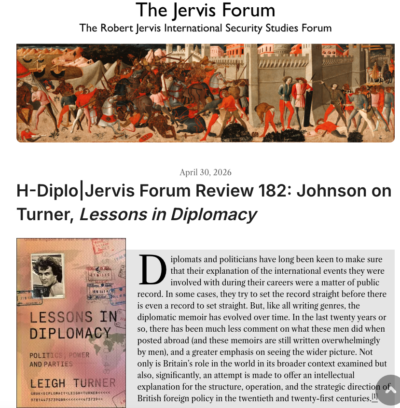
Throughout 2024 and 2025 I have been promoting my book Lessons in Diplomacy: Politics, Power and Parties. Here’s a review from June 2025. Clicking on it will take you to Amazon.