Peru is home to some of the greatest treasures in Latin America, including Machu Picchu – see below. You can use the links in the next para to jump down. Other posts covering my Patagonia to Costa Rica trip include Chile (including Patagonia), Ecuador (including the Galapagos) Colombia (including Medellin) and Costa Rica (including Nosara Beach and the gold museum). I’m publishing a few other pictures on social media using the hashtag #patrica.
Peru Stories
- Peru: flying to Cusco
- Cusco
- Religion in Cusco
- Saqsayhuaman
- The Sacred Valley
- Ollantaytambo
- Machu Picchu
- Lima
- Feedback
Peru: flying to Cusco
A cancelled connecting flight from San Pedro en route to Cusco means a 3 a.m. rise and seven hours in transit at Santiago Airport. The wait is curiously enjoyable: lunch is tasty, I catch up on some writing, I relax. Is it the lack of choice? In an extraordinary location, you always feel, FOMO-style, that you should be out exploring things, absorbing the local culture. In the airport all I can do is read and write. Or maybe it’s just the euphoria of no sleep plus a massive airport coffee.

Open-cast mine in the Atacama Desert
Having cracked the seating allocation process on LatAm Airlines, I revel in a window seat on the Santiago-Cusco flight along the Pacific coast. Cliffs plunge into the sea; a dusty highway arrows across the desert, past a field of solar panels, culminating in a tiny shoreside hamlet. It’s bleak but – thanks to mineral resources – economically valuable. All the land from Antofagusta as far north as Arica (consult your atlas) used to belong to Bolivia and Peru until the War of the Pacific between those countries and Chile in 1879-84. It ended in victory for Chile, cutting Bolivia off from the sea and acquiring territory from Bolivia and Peru of around 187,000 square kilometres – a little less than the whole of the United Kingdom.

Immigration queue in Cusco
Later, over southern Peru, a vast lake shimmers in the distance – could that be Titicaca? Clusters of snow-capped Andean peaks reappear, followed by a vertiginous descent, mountains and favelas at our wingtips, into Cusco. The immigration officials are courteous but thorough, taking full biometrics. Signs announce we’ve arrived in the Andean Community, comprising Peru, Columbia, Ecuador and Bolivia (but not Chile).
Peru: Cusco

Cusco (Cuzco is a Spanish spelling) lies in a valley surrounded by mountains and ringed by Inca sites. The rise and precipitate fall of the Inca empire, and the extraordinary remains it left behind, tell a compelling story. There were also plenty of pre-Inca civilisations in South America. The Museum of Pre-Columbian Art argues that Mexico and South America were two of six cradles of civilisation in the world, the others being China, India, Egypt and Mesopotamia.

Women ready to pose with llamas
The city is as scenic for its people as for its sites. Many women dress in traditional costumes. Some clutch a llama, often combined with a baby or a baby llama, or both, to pose for photos. But many others are just going about their business, or are even tourists themselves. There seem to be far more descendants of indigenous peoples in Peru than in Chile. Presumably descendants of the Incas form much of the population. But what do any of us really have to do with the populations who centuries ago occupied the geography we now inhabit?

Tourists in traditional dress. According to my “Sacred Valley” guide, (see below) they are Aymara from lake Titicaca, identifiable by their small hats and big skirts
I ask a young waitress in a cafe how she finds living in Cusco. ‘It’s fine,’ she says. ‘But there are hardly any decent malls.’

Street vendor
When you’re far from home and the locals are eating unfamiliar things – in Peru, guinea pig or alpaca – it’s tempting to try them. Most – certainly alpaca – are forgettable. “Inca Cola” tastes like American Cream Soda and is owned by Coca Cola. At a rooftop bar near the San Cristóbal church “with the best 360-degree view of Cusco” I feel I must try a pisco sour. Unlike the Chilean version, it’s made with egg-white and seems creamier, sweeter and less icy. At the risk of causing an international incident, my first take is that I prefer the Chilean version. But I think more research is called for. A later test at the Ambra rootop bar at the Pullman Lima Miraflores suggests Peruvian pisco sours may yet have much to offer.

Alpaca burger with Inca Cola

Better: a Pisco sour
The centre of old Cusco is full of pre-1532 Inca buildings whose foundations the Spanish conquerors used to erect new structures. It wasn’t by chance: the information boards at the “Triumph Church” (yes) and Basilica Cathedral spell out that the Spaniards made a point of building on holy Inca sites to demonstrate sovereignty and destroy Inca religious and power structures.

Spanish building on Inca foundations
One of the starkest examples is Qorikancha or Temple of the Sun. This is a Dominican priory, still working, which was built from 1538 – five years after Pizarro arrived in Cusco to complete the conquest of the Inca empire. The complex stands atop colossal Inca foundations, and incorporates two complete Inca buildings, their stonework so perfect it appears they were built yesterday. One crucifix hangs above a surviving Inca wall. There are statues of dogs holding torches in their mouths. A sign explains that St Dominic’s mother had a dream of a dog holding a torch, symbolising the order’s mission to spread the light of the gospel around the world and guard against heresy. The Latin phrase “Domini canes” means “the hounds of God”.

Crucifix above Inca wall at Dominican Priory
Religion in Cusco
Disconcertingly, much of the artwork at Qorikancha highlights the role of the Dominicans in subjugating the Incas. The prize painting, “Meeting of Francisco Pizarro with Inca Atahualpa in Cajamarca”, as the accompanying panel says, “highlights the role of the Dominican Order in the conquest of Peru”. It reminds me of the artwork in the Foreign Office main building, of which I say in Lessons in Diplomacy: “If an incensed conceptual artist had set out to construct an immersive sculpture to satirise Britain’s history of colonial exploitation, they could not have come up with a more spectacular artwork than the entire Foreign Office main building.” The Dominicans seem to be doing a similar job.

The Archbishop’s palace in Cusco
Religion seems to have played an oversize role in Spanish colonisation. The archbishop’s palace, too, squats on Inca foundations. The interior is massive and exquisite: courtyards, fountains and colonnades, and a huge number of “Cusco School” paintings, nearly all of religious themes such as the Corpus Christi processions of 1675-80. Colonial Cusco seems to have been a powerhouse of religious art in the 17th and 18th centuries: it’s a breath-taking show of wealth and power.

A volcano-shaped Virgin Mary
The collection features many images of the Virgin Mary, who labels explain had a cult following in Andean Catholicism. Some experts have suggested that the triangular outline of the Virgin in nearly all the paintings is designed to represent a mountain. Mountains were holy to the indigenous people (they still are: see below). Once you see it, you can’t unsee it.

Basilica Cathedral
On the Plaza de Armas in the city centre are four huge churches: the Basilica Cathedral, the Triumph Church, the Church of the Holy Family, and the Church of the Society of Jesus (Jesuits). All are jaw-dropping in their scale and the richness of their decoration. The fact the cathedral is filled with clouds of incense makes it seem larger still. The 1636 choir (“pure Cusco cedar”) is richly carved. Each of the 64 stalls, the explanatory sign explains, has arm-rests with “representations of partly clad women in a squatting position… representing the Pilgrim Mother church”.
A Japanese couple ask their guide why there are so many depictions of Christ on the cross – there seem to be hundreds, often several on a single altar. The guide frowns. ‘See that cross there, it’s green,’ he says, drawing on the knowledge he has. ‘That shows it’s an Andean cross or Chakana, an ancient pre-Catholic symbol and painted green to symbolise life.’
Saqsayhuaman

Walls at Saqsayhuaman
Saqsayhuaman is the remains of an Inca fortification built above Cusco in the 15th century at an altitude of 3,700m. It features tens of thousands of huge stones, some weighing hundreds of tons, fitted together in an apparently random pattern. The saying is that they fit so tightly you can’t squeeze a cigarette paper between them. It’s true. The scale is remarkable: any one corner of the site would make a world-class archaeological site elsewhere. The trashing of a nine-million-strong civilisation by a handful of conquistadors and billions of germs is a constant, elegiac reminder, if one were needed, of the fragility of our own civilisation and of the political and societal structures designed to glue it together.

How to keep civilisation secure
At several places teams are digging in the ground among endless stones and trees. Reports suggests there is much more of Saqsayhuaman underground. “Every time we try to lay some pipes in Cusco,” a guide says, “we find Inca remains”. Although three sets of walls run in a zigzag pattern alongside an open area, not a single building remains. The Spaniards took every stone they could move to build their new city. So did later Peruvians: it was only after the earthquake of 1950 underlined the superb quality of the Inca stonework that proper preservation measures were put in place. The foundations of three towers have been found in the past 25 years; there is talk of sacrificial sites. But the form and function of what stood here in its prime has been lost in the mists of time.

A guide at Saqsayhuaman asks his Brazilian guests: ‘do you want the regular tour or the VIP tour?’ ‘What’s the difference?’ a guest asks. ‘VIP!’ the guide replies. ‘VIP!’
Luckily I climb the 283 steps to the hilly site on my third day in Cusco, by which time I can manage more than a flight of stairs without stopping to catch my breath. Tracks lead everywhere, including to the neighbouring “Q’enqo” site. Huge, inexplicable, exquisitely carved rocks lie around as if abandoned on their way to some uncompleted structure. People talk about the number of angles on the Inca stones as evidence of their extraordinary masonry skills.

Masonry skills
Seeing masses of minibuses parked at the main entrances makes me pleased to be here independently, with time to mooch around the ruins. It’s a balance: some sites are hard to access independently, a guide can add value, and a good tour can be sociable. But nothing’s worse than a bad tour.
Peru: the Sacred valley

At the Sacred Valley
The “Sacred valley of the Incas” lies north of Cusco. The dramatic cleft between rugged peaks was, according to my knowledgeable guide Patricia, little populated until the Spaniards arrived. Most Incas lived in the mountains. But the Spaniards built churches and established settlements in the valleys to evangelise and control local populations, partly depopulating the highlands.

Souvenir vendor at the Sacred Valley
The result is a series of high-altitude, deserted Inca remains overlooking a richly-cultivated valley floor. Grain stores perch on mountainsides, served by tantalising remnants of the Incas’ 30,000 km Qhapaq Ñan road network. At Moray, exquisite terraces sink symmetrically into the ground. Different soils found on the terraces and the extreme microclimates created by the different depths support the thesis that Moray was a kind of agricultural test-bed, perhaps contributing to the existence of over 4,000 types of potatoes in Peru.

Moray terraces
I ask Patricia, who is from a rain forest area in north-east Peru, about her name. She says many people in Peru have western names – they’re particularly popular amongst the Quechua people we are due to visit for a “cultural exchange”. Our driver, Edward, is also a Quechua.

Warm welcome at Misminay
When Sinead of Travel Differently suggested a cultural visit in the Sacred Valley I resisted. I had had enough of making appreciative noises in the face of folkloric entertainment as a diplomat. The thought of gawping at local people performing humiliating rituals chilled me. Yet when we arrive at the village of Misminay, Martina, Genevieve, Agripina, Esteban, Ruso, Martín and Alejandrina seem so delighted to see us that my cynicism melts away. We drink mint tea and inspect different types of maize and potatoes. ‘This one is poisonous,’ Patricia says of a bright green sprouting tuber. ‘You have to prepare it carefully. This one – ’ a tiny white potato ‘ – you can freeze dry it, it keeps for years.’

Exotic Peruvian tubers (and tasty tuber-based pud)
Esteban tells us about a government programme to train villagers to host tourists. He used to be a porter on the Inca trail. ‘We got $15 for four days,’ he says, ‘Now they get ten times more, plus health insurance.’ We watch a ceremony to honour Apu, the spirit of the mountains, and Mother Earth. These beliefs exist alongside Catholicism. The Trinity is everywhere: a trio of coca leaves; the upper world of the gods, the earthly world, and the lower world of the dead; the snake, the puma and the condor; the Quechua saying “don’t steal, lie or be lazy”. Martin addresses local mountains by name and put coca leaves and chichi – fresh home-brewed beer – in the ground for Mother Earth: ‘she feeds us, so we feed her’.

The place seems a roaring success. Other visitors arrive while we are there, and a fire-pit is being built to prepare food for a wedding party. Two bulls decorate the gate. ‘They’re for fertility and success,’ Patricia says. ‘The Spanish brought them, but they’re very popular.’
Ollantaytambo

Walls at Ollantaytambo temple complex
Ollantaytambo is a former Inca settlement with an incomplete temple complex above steep terraces on one side, and a series of vertiginous storehouses on the other. The temple complex features the same superlative masonry of asymmetrical, precision-fitted stone monoliths as Saqsayhuaman. But here the stone is not limestone but granite, making the craftsmanship even more extraordinary. The Pinkuylluna grain storehouses are in about as inconvenient a place as one could imagine – clinging to a cliff hundreds of metres above the town at the top of a vertiginous trail. The idea was for wind and cold at the higher altitude, together with a ventilation system, to preserve the contents.

Grain storehouses on mountainside
Peru: Machu Picchu
Edward the driver picks me up at 7.20 to catch the train to Machu Picchu from Ollantaytambo. By 7.45, many uniformed school children are trudging along the dusty road. ‘School starts at 8,’ Edward says. ‘My wife will be taking our son there now.’ I ask if the language of instruction is Spanish or Quechua (Edward’s language). ‘It’s Spanish,’ he says, ‘but Quechua lessons are obligatory. He can take English lessons, too. But that’s optional.’

The Machu Picchu train
The train journey from Ollantaytambo to Machu Picchu is only 42 miles. But the 90-minute trip (‘un viaje panoramico’, the staff announce) takes in Inca ruins, gushing rivers, soaring mountains and the transition from the temperate highlands of the Sacred Valley to the fringes of the mighty Amazon. Welcome to the jungle.

Excellent views
Machu Picchu is at 2,430m, over a thousand metres below Cusco, and the altitude no longer bothers me. But several passengers still have tissue paper up their nostrils to counter nose-bleeds. The train enters the cloud forest. Lush vegetation embraces the rail tracks, which run within touching distance of countless cliffs and spurs. Exquisite stone staircases climb enticingly into the foliage.

The bus queue
Queueing in the rain for the bus from Machu Picchu station to the mountain-top I hear Welsh spoken nearby and meet Catrin and Rhian from near Porthmadog. Catrin says she was once talking Welsh to a friend on the Bolivia-Peru border when an Argentine from Patagonia came and introduced himself in the same language. She wants to visit Welsh-speaking Patagonia, ideally when the Eisteddfod is on. I tell them about my great great grandfather, Robert Jones Derfel, a Welsh poet and political firebrand.

It’s raining when I and my guide Wagner arrive at Machu Picchu. Mist rises from the forests and cloud engulfs Huayna Picchu, the famous steep mountain behind the miraculously intact settlement. The result is mysterious and magnificent. It’s not too crowded, perhaps because it’s the low (rainy) season. The site is extensive: terraces spread down both sides of the mountain. Walkers return from climbing Huayna Picchu itself – it turns out that the top of the mountain is covered in Inca structures, visible in the second picture at the link.

Taking my book out of my bag for a photograph I am approached by Suneesh and Roma Kaul, from San Francisco. ‘Are you Leigh Turner?’ they ask. They tell me they’ve read “Lessons in Diplomacy”, having found it in a bookshop in San Francisco, are honoured to meet me. Could we do a photo?

Further around the “circuit” of the citadel a tour group of Russians blocks the path. Many are wearing new Peruvian ponchos. When I politely ask them in Russian if we can pass, we get talking. They’re from St Petersburg and are intrigued to hear that I visited the city when serving as a diplomat in Moscow. Half an hour later we meet again and their guide, Lena, ask what I think about the political situation and the war. I show her the chapter in “Lessons in Diplomacy” entitled “How to understand Putin’s war on Ukraine”.

Looking down at terraces and jungle
As Lena leafs through the book, someone else asks what I think will happen next. I hesitate and say that, on balance, this is not the time or the place to discuss it. But clearly, I say, the war is a mistake. ‘I agree it’s a mistake,’ one of the tour party says. ‘So many people are dying.’ ‘Let’s not talk about politics,’ another woman says, and pushes on. ‘Where can I get this book?’ Lena asks. ‘I’m not sure it would be safe for you to read it in Russia,’ I say. ‘It’s OK,’ she says. ‘I live in Peru.’

On the train back to Ollantaytambo, Lena turns out to be sitting next to me. I ask how she came to be in Peru. She says she met her Peruvian husband in the street when he was studying at the Patrice Lumumba Peoples’ Friendship University in Moscow. She’s been living here for years. Both her sons are studying in the US. They don’t want to go back to Russia, in case they get called up for military service.
Edward is waiting for me at the station. He speaks Spanish to me, slowly so I can keep up. Observing sheet lightning in the valley ahead, I say the weather in the mountains is unpredictable. ‘Like women,’ Edward says. ‘Very unpredictable.’ He tells me about his wife, who is from Chumbivilkas near Cusco. ‘They’re so argumentative there,’ he says. ‘Neighbours always fighting, exchanging blows.’ He uses words, golpes, and peleandos, I have to look up. ‘They even have a fighting festival there, it’s on the internet.’ He’s right.
Although Peru is a Catholic country, marriage is not widespread, Edward says. He isn’t actually married to the woman he calls his wife. His parents weren’t married either. Teenage pregnancy is a problem in Peruvian schools, he says. ‘Girls and boys start dating when they’re twelve. Twelve! If I ever have a daughter, I’ll keep a close eye on her, I’ll be very strict. Maybe put her in a convent.’ He asks if I’ve tried guinea pig, a Peruvian delicacy. ‘They’re tasty,’ he says, ‘and very healthy. No calories. But they’re expensive, we only have them on special occasions. My grandmother keeps some at home, around thirty, so we always have some available.’
Later in Quito I visit the city museum. A reconstructed 16th century indigenous hut includes, in addition to pots of grain and agricultural implements, a dozen guinea pigs running around the floor.
Lima

Lima Pacific sea-front
My driver from Lima Airport, Carlos, is worried about crime. ‘Things are much better now than they used to be. We had Shining Path guerrillas in the ‘80s, stealing children to turn them into soldiers, lots of peasants fled the countryside, Lima was in chaos. Peru is a stable country now, despite the politics, we’ve had three presidents in five years. But there’s a crime wave, especially kidnappings. It’s because of the immigrants from Venezuela, there are too many. Two million, they say, but only 600,000 have registered. Where are the others? We trust the army. But the police – tricky. They’re all taking bribes.’

In Miraflores (Malecon de Ingleses, or “English boulevard”)
Carlos tells me the area I’m staying in, Miraflores, is very safe: ‘there are loads of police everywhere.’ At first, this doesn’t seem very reassuring. But after I’ve visited the town centre, I realise he’s right: some other areas have a distinctly seedy air, and many houses are fortified with high, spiky fences. Whatever is happening to immigration, many shops and restaurants have signs saying “help wanted”.

Fortified house in San Isidro district
The Huaca Pucllana is an adobe and clay pyramid in the heart of Lima. Despite being big (22m high, hundreds of metres long) and old (built around 100 to 650 AD) it’s somewhat featureless. My taxi from there into town, an antique Chevrolet van with disintegrating upholstery and no working seatbelts, becomes stuck in endless jams; the journey takes over an hour. The sound system plays “Total Eclipse of the Heart”, by Bonnie Tyler, and “Dancing in the Dark”, by Bruce Springsteen, repeatedly, before switching at last to George Michael’s “Careless Whisper”.

Soldier on ceremonial duty in Plaza Mayor (with passing cleaner)
I remark on the stationary traffic. ‘It’s always like this at this time,’ the driver says. ‘And in the morning. And in the evening. And at night.’ On a street in the city centre a middle-aged woman wearing a red dress that showcases her prominent breasts sits slumped in a doorway screaming into her phone. ‘She’s always like that, too,’ he says. When I walk back down the same street later she is indeed still there, this time upright. She propositions me. I politely decline.

Pavement stickers
Near the Plaza Mayor, shops selling wedding dresses fill an arcade. As in Cusco, women offering massages are everywhere. Even the pavements are covered in stickers offering “relaxing massages”. A cheerful matron approaches a grey-haired man limping along in front of me and offers a massage for the improbably low price of ten sol (about £2.50). He grins at her: ‘How about I give you a massage?’ She cackles with laughter. ‘That’d be nice.’

Statue of Pizarro with indigenous people
A tall stone pediment supports a monumental bronze statue of a warlike Pizarro, riding on a horse. The side of the pediment features three indigenous men, one holding up a banner in Spanish saying “we are free”. A sign outside the presidential residence on the Plaza Mayor describes Pizarro as “conqueror of Peru, founder of Lima [and] one of the most controversial figures in our history.”

A row of surf schools is graced by a statue of a surfer
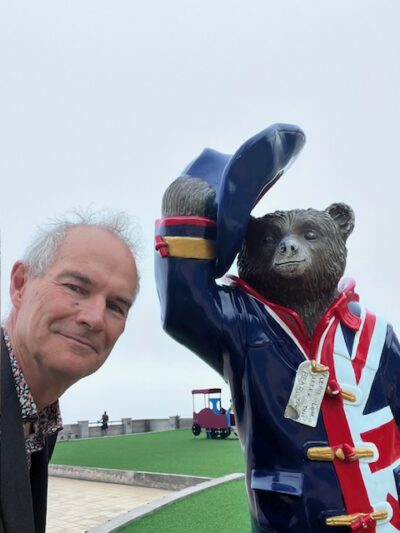
By comparison with the city centre, the districts of Miraflores and Barranco, on the Pacific coast, are oases of calm affluence. Surfers throng the waves; high-rise apartment blocks line cliffs that rise above the pebbly beaches. A cliff-top promenade teems with joggers and dog-walkers. Near the British embassy is a statue of Paddington Bear, a gift of the British government, complete with a label saying “Please look after this bear”.

Chile, Ecuador, Colombia and Costa Rica
Other posts cover the rest of my journey from Patagonia to Costa Rica, including Previous posts explore Chile, Ecuador, Colombia and Costa Rica.
Feedback
I’d welcome feedback on these travel blogs, in the comments or direct by e-mail. Is this too much detail? Too few/too many photos? Other thoughts? Let me know. I’m also posting a few photos on Instagram and elsewhere, with the hashtag #patrica (for Patagonia to Costa Rica).
If you enjoy my travel writing, you may like to explore my US road trip piece from 1979 “A voyage around America“; my piece The Russians: Vladivostok; or my recent account of a disastrous boat trip to visit the dragons of Komodo.
Sinead at Travel Differently organised my trip-of-a-lifetime from Patagonia to Costa Rica.