The Rosie Project by Graeme Simsion is a near-perfect, laugh-out-loud comedy. Yet few people in the UK seem to have heard of it.
A comedy about love
The Rosie Project is a comedy about Don Tillman, a genetics professor, and his quest for love. The book implies, but never states, that Don is on the autism spectrum. He craves, and lives, an organised, scheduled, efficient life – for example, cooking himself the same dish every Monday, every Tuesday, etc. Despite, or perhaps because of his brilliance, he finds it hard to relate to people. When Don decides it is time to find a mate – a challenge he refers to as “the Wife Project” – his first action is to design a massive questionnaire that prospective candidates must complete.
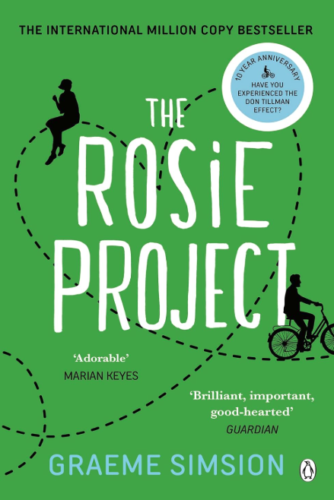
The cover of a recent edition of “The Rosie Project”
The Rosie Project: Misunderstandings
Much of the humour in the book derives from Don’s first person account of other people’s actions. Don frequently misunderstands things that are clear to the reader. For example, Don shows his proposed questionnaire to his friend Gene, a womanising colleague, and Gene’s wife Claudia. Gene asks why the questionnaire includes nothing about appearance.
- ‘I thought you might have wanted to get an idea of what they look like,’ said Gene. ‘There’s a question on fitness,’ I said. ‘I was thinking about sex,’ Gene said. ‘Just for a change,’ said Claudia, an odd statement as Gene talks constantly about sex.
Claudia is criticising her husband for his obsession with sex, but Don does not understand this.
Enter Rosie – and more misunderstandings
Eventually, Don meets Rosie, who appears totally unsuited for the Wife Project. A psychology PhD student, she works part-time in a bar to help finance her studies. The first time she comes to Don’s flat, she catches him off-guard:
- Two days later, Rosie appeared at my apartment. It was 8.47 p.m., and I was cleaning the bathroom… I buzzed her upstairs. I was wearing my bathroom-cleaning costume of shorts, surgical boots and gloves but no shirt. ‘Wow.’ She stared at me for a few moments. ‘This is what martial-arts training does, is it?’ She appeared to be referring to my pectoral muscles.
We infer from this that Don has a gorgeous body and that Rosie is admiring it. But Don has no idea.
Simsion uses the same device when Don’s mother phones while he is with Rosie:
- It was embarrassing to have Rosie listen to a personal conversation, and I did everything I could to terminate it quickly, keeping my responses as brief as possible. Rosie started laughing… and making funny faces. ‘Your mother?’ she said when I was finally able to hang up. ‘Correct. How did you guess?’ ‘You sound like any sixteen-year-old boy talking to his mum in front of – ‘ she stopped. My annoyance must have been obvious.
The readers understands that Rosie has been about to say “in front of his girlfriend”, but has caught herself. Similarly, Don misunderstands Rosie’s comments about the Wife Project.
- ‘So,’ said Rosie. ‘Are you still doing it? The Wife Project?’ I explained that the project was still technically active, but in the absence of any qualified candidates there had been no progress. ‘What a shame,’ said Rosie. ‘The perfect woman hasn’t checked in yet.’ ‘I would assume that there is more than one candidate who meets the criteria,’ I said, ‘but it’s like finding a bone-marrow donor. Not enough registrations.’ ‘I can only hope that enough women realise their civic duty and take the test.’ It was an interesting comment. ‘It’s entirely optional,’ I said.
Clearly Rosie finds the whole project absurd – she later lectures Don on treating women like objects. But Don does not understand her feelings.
The Rosie Project: Men’s inability to understand others – or themselves
Simsion uses Don’s extreme awkwardness with women to highlight how incapable all men are of interpreting others’ feelings – or their own. When Gene advises Don to invite Rosie to the faculty ball, Don tells him it is out of the question:
- ‘Rosie and I discussed the question of a relationship explicitly. Neither of us is interested.’ ‘Since when do women discuss anything explicitly?’ said Gene.
Gene is, typically, sexually stereotyping woman. Conversely, the point that in all dialogue, as well as relationships, what is not said is often as important as what is said, is valid. But Don, who always thinks literally, cannot grasp it.
Don cannot interpret his own behaviour. When it emerges that Rosie doesn’t know who her father is, Don offers to help her find out, using DNA samples to winnow down a list of potential candidates. He calls this “the Father Project”. He invests a huge amount of time in it, but cannot understand why:
- The Father Project… had consumed enormous time for zero outcome. My arguments for pursuing it had always been weak, and I had done far more than could reasonably be expected of me. If Rosie wanted to locate and obtain DNA from the remaining candidates, she could do so herself… Once again, logic and emotion were not in step. I wanted to continue the Father Project. Why?
The reader understands that Don finds Rosie attractive. But Don cannot see it, because according to his questionnaire of supposedly objective criteria, Rosie is totally unsuitable for him.
Don Tillman: a million obstacles
When Don attends the faculty ball, he researches what he should wear. He arrives in a full morning suit with top hat and tails. His date, Bianca, is surprised (‘You’ve… really dressed up.’) They then enter the ballroom together:
- Everyone turned to look at us, and it was obvious that we had made an impression… Then I noticed that the men were almost without exception dressed in black suits with white shirts and bowties. None wore tails or a hat. It accounted for Bianca’s initial reaction. It was annoying, but not a situation I was unfamiliar with. I doffed my hat to the crowd and they shouted greetings.
Poor Don has spent a lifetime being the odd one out, and compensating for it by playing the fool.
Later at the ball, Don finds dancing with Rosie is easy and enjoyable:
- At the end of the night, the band played a waltz, and when it was finished I looked around and it was just Rosie and me on the dance floor. And everyone applauded again. It was only later that I realised that I had experienced extended close contact with another human without feeling uncomfortable. I attributed it to my concentration on correctly executing the dance steps.
We know Don has enjoyed dancing with Rosie. We know he finds her attractive. Don has no idea. This leads to disaster: when she shares a taxi with him, she invites him upstairs, but he panics and says no.
- Rosie opened the taxi door. I willed her to go. But she had more to say. ‘Don, can I ask you something?’ ‘One question.’ ‘Do you find me attractive?’ Gene told me the next day that I got it wrong. But he was not in a taxi, after an evening of total sensory overload, with the most beautiful woman in the world. I believed I did well. I detected the trick question. I wanted Rosie to like me, and I remembered her passionate statement about men treating women as objects. She was testing to see if I saw her as an object or a person. Obviously the correct answer was the latter. ‘I haven’t really noticed,’ I told the most beautiful woman in the world.
A good romantic comedy consists of having a couple attracted to one another, then facing a million obstacles. In The Rosie Project, Don has several million obstacles at least.
Exquisite misunderstandings between Don and Rosie
Later, Don has second thoughts about Rosie. But again, he gets it wrong. Here, for example, he misinterprets what Rosie says when they meet in the presence of another man, Stefan:
- ‘I need to talk to you in private,’ I said to Rosie. She looked at me very directly. ‘I don’t think there’s anything we need to say in private.’ This seemed odd. But presumably she and Stefan shared information in the same way that Gene and I did. He had accompanied her to the ball. ‘I was reconsidering your offer of sex,’ I said. Stefan put his hand over his mouth. There was a long silence – I would estimate six seconds.
Here, Rosie meant “since you told me you’re not interested in me, we have nothing left to discuss in private”. Don understood this to mean “We can discuss anything you want in public”. The same occurs later when Rosie asks Don whether, if he ever married, he would be faithful. He replies, deliciously:
- ‘If I find a partner, which seems increasingly unlikely, I wouldn’t want a sexual relationship with anyone else. But I’m not good at understanding what other people want.’ ‘Tell me something I don’t know,’ said Rosie for no obvious reason. I quickly searched my mind for an interesting fact. ‘Ahhh… The testicles of drone bees and wasp spiders explode during sex.’
Slowly, Rosie changes Don
But, slowly, proximity to Rosie’s straight-talking and affection is changing Don. We see this when he finds himself alone with an elderly woman suffering from dementia:
- Then Margaret Case woke up. She opened her eyes and looked directly at me. ‘Geoffrey?’ she said, quietly but very clearly. Was she asking for her husband or for her long-dead son? There was a time when I would have replied without thinking, ‘They’re dead,’ not out of malice but because I am wired to respond to the facts before others’ feelings. But something had changed in me, and I managed to suppress the statement.
Simsion uses the “we understand but Don doesn’t” trope to excellent effect when Don and Rosie fly to the US together and he is treated with great deference by the airline staff:
- As we drank Champagne in the lounge, I explained that I had earned special privileges by being particularly vigilant and observant of rules and procedures on previous flights, and by making a substantial number of helpful suggestions regarding check-in procedures, flight schedules, pilot training and ways in which security systems might be subverted. I was no longer expected to offer advice, having contributed ‘enough for a lifetime of flying’. ‘Here’s to being special,’ said Rosie.
Similarly, Don finds Rosie’s choice of guidebook puzzling:
- We walked uptown. Rosie was looking at a guidebook called Not for Tourists, which seemed a very poor choice.
Rosie gets to know Don better, and we hear more about his past:
- Somewhere in a medical archive is a twenty-year-old file with my name and the words ‘depression, bipolar disorder? OCD?’ and ‘schizophrenia?’ – the question marks are important – beyond the obvious observation that I was depressed, no definitive diagnosis was ever made, despite attempts by the psychiatric profession to fit me into a simplistic category. I now believe that virtually all my problems could be attributed to my brain being configured differently from those of the majority of humans.
Slowly, Don realises that he likes being with Rosie:
- In the last eight weeks I had experienced two of the three best times of my adult life, assuming all visits to the Museum of Natural History were treated as one event. They had both been with Rosie. Was there a correlation? It was critical to find out.
After a day out in New York organised by Rosie, she asks him a question:
- ‘How was it?’ said Rosie as we walked back to the hotel. ‘The best day of my adult life,’ I said. Rosie seemed so happy with my response that I decided not to finish the sentence: ‘excluding the Museum of Natural History.’
Rosie’s feelings about men
Rosie later sums up her feelings about men:
- ‘So, I don’t trust men. I don’t believe they’re what they say they are. I’m afraid they’re going to let me down. That’s my summary from seven years of studying psychology.’ This seemed a very poor result for seven years of effort, but I assumed she was omitting the more general knowledge provided by the course.
Later, Rosie considers whether she could be in a relationship with Don, and he responds, showing that he is trying to change:
- ‘Don… I could have fun with you. The best times. But, you know I couldn’t eat lobster every Tuesday, right?’ ‘I’ve abandoned the Standardised Meal System. I’ve deleted thirty-eight per cent of my weekly schedule, excluding sleep. I’ve thrown out my old t-shirts. I’ve eliminated all of the things you don’t like. Further changes are possible.’ ‘You changed yourself for me?’ ‘Only my behaviour.’ ‘Rosie was silent for a while, obviously processing the new information. ‘I need a minute to think,’ she said. I automatically started the timer on my watch.
The Rosie Project: A joyous, poignant romantic comedy
I’ve tried to avoid too many spoilers in these quotes. I’ve also omitted my favourite scene, when Don Tillman trains as a bartender to collect DNA samples, with comic results. Overall, The Rosie Project is a joyous, poignant romantic comedy which also manages to explore relationships in a refreshing and often hilarious way. As Rosie points out, Don is different from most people. But many of his foibles and lack of sensitivity are the same as those of many men – just more extreme. As she says, “you’re no different from every other man I know in objectifying women – just more honest about it.” Discuss.
What to do next
I recommend “The Rosie Project”, which you can buy on Amazon or in bookshops. Enjoy! I have plans for my own series of romantic comedies. Watch this space – or feel free to have a look at my published books to date.