A description of “love-making” in the 1867 novel “The Last Chronicle of Barset” illustrates the wit, wisdom and charm of underrated 19th century novelist Anthony Trollope. It also explores the pleasures – and dangers – of extra-marital adventures.
Love-making: eternal truths from Anthony Trollope
I was recently reading aloud to my 96-year-old mother, whose eyes are not as sharp as they were. She is tackling on her Kindle The Last Chronicle of Barset, the ultimate and longest of Anthony Trollope’s Barsetshire novels.
Reading out loud is rewarding and often reveals elements you have skipped over, or forgotten, when you read silently. Amongst other things, I came across an elegant and perceptive passage about “love-making” – what we might today call flirting. I reproduce it below. It struck me as entirely relevant to the 21st century. Trollope nailed the pleasures – and dangers – of flirting.
In the following excerpt, Mrs Dobbs Broughton, the bored wife of an unsympathetic millionaire, flirts with young painter Conway Dalrymple. Neither plans any infidelity. But both enjoy the “game” of love-making – flirting – in the knowledge that nothing will come of it. The problem comes when Mrs Dobbs Broughton’s husband returns home, drunk, and is irritated to find Dalrymple just leaving.
Mr Dobbs Broughton doesn’t understand the rules of the game.

My Trollope Society complete edition, in Istanbul 2015
“None of these games are equal to the game of love-making”
Trollope begins with a digression on the advantages of different “games”:
“Croquet is a pretty game out of doors, and chess is delightful in a drawing-room. Battledoor and shuttlecock and hunt-the-slipper have also their attractions… But none of these games are equal to the game of love-making,—providing that the players can be quite sure that there shall be no heart in the matter. Any touch of heart not only destroys the pleasure of the game, but makes the player awkward and incapable and robs him of his skill. And thus it is that there are many people who cannot play the game at all. A deficiency of some needed internal physical strength prevents the owners of the heart from keeping a proper control over its valves, and thus emotion sets in, and the pulses are accelerated, and feeling supervenes. For such a one to attempt a game of love-making, is as though your friend with the gout should insist on playing croquet. A sense of the ridiculous, if nothing else, should in either case deter the afflicted one from the attempt. There was no such absurdity with our friend Mrs. Dobbs Broughton and Conway Dalrymple. Their valves and pulses were all right. They could play the game without the slightest danger of any inconvenient result;—of any inconvenient result, that is, as regarded their own feelings. Blind people cannot see and stupid people cannot understand,—and it might be that Mr. Dobbs Broughton, being both blind and stupid in such matters, might perceive something of the playing of the game and not know that it was only a game of skill.”
Trollope observes that the “game” of love-making can only be played by people who have full control over their emotions. Is he criticising Mrs Dobbs Broughton and Conway Dalrymple? You decide.
“The charms of a fevered existence”
Trollope explores whether Mrs Dobbs Broughton and Conway Dalrymple are capable of love. He suggests that the life-long relationship true love entails will tend to settle into a routine. Some people in such relationships will therefore seek out “the charms of a fevered existence” by flirting. This second excerpt follows directly from the first, above:
“When I say that as regarded these two lovers there was nothing of love between them, and that the game was therefore so far innocent, I would not be understood as asserting that these people had no hearts within their bosoms. Mrs. Dobbs Broughton probably loved her husband in a sensible, humdrum way, feeling him to be a bore, knowing him to be vulgar, aware that he often took a good deal more wine than was good for him, and that he was almost as uneducated as a hog. Yet she loved him, and showed her love by taking care that he should have things for dinner which he liked to eat. But in this alone there were to be found none of the charms of a fevered existence, and therefore Mrs. Dobbs Broughton, requiring those charms for her comfort, played her little game with Conway Dalrymple. And as regarded the artist himself, let no reader presume him to have been heartless because he flirted with Mrs. Dobbs Broughton. Doubtless he will marry some day, will have a large family for which he will work hard, and will make a good husband to some stout lady who will be careful in looking after his linen.”
Trollope depicts married life in disparagingly: “loved her husband in a sensible, humdrum way“; or “make a good husband to some stout lady who will be careful in looking after his linen”. He compares this with “love-making”, which offers “the charms of a fevered existence”. He doesn’t say either that stable relationships are not rewarding (see below), or that “love-making” offers a solution. Rather, he is observing that life is complex; and happiness entails both rewards and sacrifices.
“You’re here a doosed sight more than I like”
The third and final excerpt follows directly from the second. Dalrymple, leaving the house, runs into Mr Dobbs Broughton, drunk. Dalrymple scarpers, leaving Mrs Dobbs Broughton to face the music.
“But on the present occasion he [Dalrymple] fell into some slight trouble in spite of the innocence of his game. As he quitted his friend’s room he heard the hall-door slammed heavily; then there was a quick step on the stairs, and on the landing-place above the first flight he met the master of the house, somewhat flurried, as it seemed, and not looking comfortable, either as regarded his person or his temper. “By George, he’s been drinking!” Conway said to himself, after the first glance. Now it certainly was the case that poor Dobbs Broughton would sometimes drink at improper hours.
“What the devil are you doing here?” said Dobbs Broughton to his friend the artist. “You’re always here. You’re here a doosed sight more than I like.” Husbands when they have been drinking are very apt to make mistakes as to the purport of the game.
“Why, Dobbs,” said the painter, “there’s something wrong with you.”
“No, there ain’t. There’s nothing wrong; and if there was, what’s that to you? I shan’t ask you to pay anything for me, I suppose.”
“Well;—I hope not.”
“I won’t have you here, and let that be an end of it. It’s all very well when I choose to have a few friends to dinner, but my wife can do very well without your fal-lalling here all day. Will you remember that, if you please?”
Conway Dalrymple, knowing that he had better not argue any question with a drunken man, took himself out of the house, shrugging his shoulders as he thought of the misery which his poor dear play-fellow would now be called upon to endure.”
Trollope concludes this excerpt by predicting that the “love-making” between Mrs Dobbs Broughton and Dalrymple will lead to problems – as indeed turns out to be the case. Dalrymple, for his part, simply shrugs his shoulders at this prospect.
I like Trollope’s liberal dispensation of epigrams – here, that one had “better not argue any question with a drunken man”.
Love-making: harmless fun, or destructive?
Much of the history of civilisation, and religion in particular, has been focused on channelling the human sex drive. This is partly because, until the 1960s, sex was inevitably bound up with pregnancy. Also until the late 20th century, women rarely had any degree of economic independence. It was difficult if not impossible for most of history for a woman to survive, let alone raise children, without a man to support her. The result: societal structures such as marriage; and immense pressure – particularly on women – not to engage in sex outside these structures. Women who had children out of wedlock were sometimes described as “ruined”. You don’t hear much about “ruined men”.
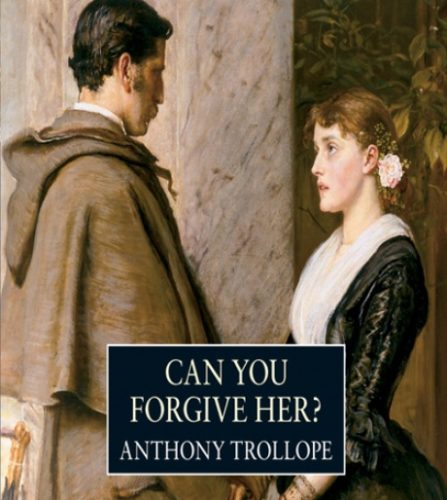
“Can you forgive her” oozes sex and politics
The tension between sinking into the warm embrace of a life-time relationship and the forbidden pleasures of sex outside such relationships is a rich source of stories. In Trollope’s time, no author would have been likely openly to advocate the latter (I’d welcome counter-examples). But many of Trollope’s novels, such as the wonderful Can You Forgive Her? explore decisions faced by women. In that book, Alice Vavasor must decide whether to choose straight-laced Mr Grey (quite unlike his EL James counterpart), or to go for dashing, scarred George Vavasor. Of course, she makes the wrong choice. In The Last Chronicle of Barset, Trollope again has characters straining against convention. None of them is shown as entirely sympathetic. Trollope highlights the risks involved in “love-making”. Yet he also points out: none of this is straightforward.
The wonders of Trollope
I have written often about the wit and wisdom of Trollope, a 19thC English novelist of prodigious output. His writing teems with brilliant insights on gender, religion and even the media. His dry wit, too, is often outstanding. For an example, see his description of “the railway sandwich” in the novel He knew he was right (scroll to the bottom of the review at the link).
Trollope may be considered an authority on love-making – or flirting. Signora Medline Vesey Neroni, in his novel Barchester Towers, is perhaps the greatest serial flirt in 19thC literature. She is almost certainly the only one with a major disability. At no point does it stop her befuddling and bewitching the men of Barchester – from the bishop down.
What to do next
If you like Trollope, you may enjoy browsing the Trollope tag on this website. My book Lessons in Diplomacy also explores how to live your life, although it contains little or no love-making. Or if you fancy some comedy of a different sort, including love-making in abundance, you may enjoy my book Seven Hotel Stories.