
Could AI destroy humankind? My new thriller “The Rage Farm” explores one way it might happen. Read an excerpt here.
The Rage Farm: how AI could destroy humankind
Could AI destroy humankind? The idea isn’t new. As long ago as 2014, Professor Stephen Hawking said that ‘The development of full artificial intelligence could spell the end of the human race.’
In 2026 we’ve seen a burgeoning of fresh warnings. Some of these have come from the very AI companies that are striving to accelerate the development of AI. When Dario Amodei, head of Anthropic, called for AI development to slow down, Elon Musk of xAI and Sam Altman of OpenAI both backed him up.
I discussed this with a friend the other day. He was sceptical. ‘How could AI destroy us?’ he asked.
‘It’s already happening,’ I said. ‘The internet teems with content designed to influence the way we think. AI will turbocharge that. We think we decide ourselves how we vote; what books we buy; what we watch. In fact, we’re buying what they want us to buy; watching what they want us to watch. We’re struggling to distinguish between reality and deepfakes. AI can turbo-charge the production of deepfake videos and other fake information, tailored to exploit your very worst fears. We’re already seeing flash mobs stirred up with zero warning to storm asylum centres or ports. We’re not far from whole societies spiralling out of control.’
‘You should write a thriller about it,’ he said.
‘I have done,’ I said. ‘It’s called “The Rage Farm”.’
Here’s an excerpt, set at the Home Office in London. You’ll never forget the word “defenestration”.
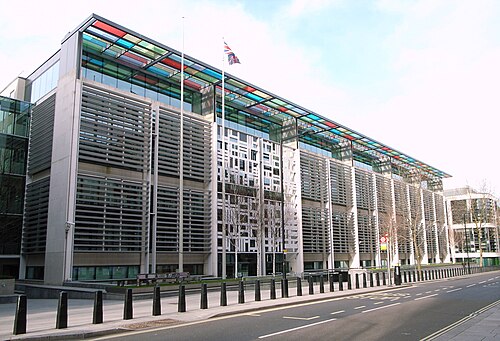
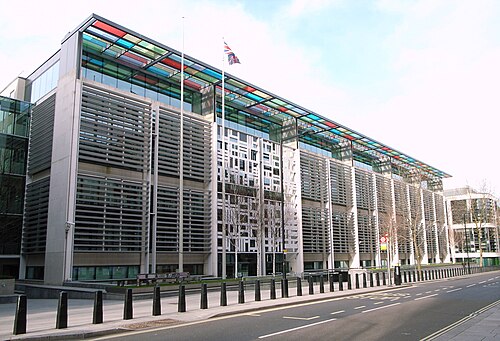
The Home Office at Marsham Street in Central London
The Rage Farm: Excerpt
08.30 London: The Home Office
Eldon Wright pulled open the kitchen cupboard and located his private stash of teabags on the crowded middle shelf. Delving amongst the crockery that crammed the space, he found his Chelsea mug, sparkling clean. He dropped the teabag in the mug, filled it to the brim with boiling water, and added a dash of fresh milk from the fridge.
The one function of the Home Office Security Officers’ Tea Club, to which Eldon paid a seven-pound-a-month subscription, was to fund a different member every week—they had a rota—to pop down to Sainsbury’s whenever the milk or teabags ran low.
Eldon returned to his post in the entrance lobby with the steaming mug held out in front of him.
‘How many times did I tell you?’ Talwar said. ‘You must take the teabag out before you put the milk in.’ Eldon’s Sikh colleague was on the morning shift with him this week, his turban blinding white. ‘A mug containing both milk and a teabag is an act of barbarism. I shall not mention your choice of football team.’
‘Didn’t you do your diversity training?’ Eldon grinned. ‘Different countries, different cultures. All equally valid.’ He paused a beat and tried to channel his dad’s patois. ‘Mon.’
‘How much tea they grow in Jamaica, then? Compared with, say, India?’
‘Depends what kind of tea you talking about. We can grow anything, back in the old country.’
‘Here’s the most hated woman in England, back from breakfast with the Prime Minister.’ Talwar pointed to a monitor showing the Home Secretary’s limousine slowing to transit a clump of demonstrators, with the help of two burly police officers. A couple of eggs landed on the back of the car, almost as an afterthought, as it sped down a ramp into the basement garage.
‘She ain’t getting much more popular,’ Eldon said.
‘Which politician is?’ Talwar said.
‘But a popular Home Secretary is an oxymoron,’ Eldon said, stretching out the vowels of the word. ‘She’s responsible for police, courts, prison, immigration and terrorism. No wonder everyone hates the Home Office.’
‘Her. They hate her. Look at that.’ Talwar pointed across the lobby, through the glass doors, to the road opposite the Home Office main entrance.
Eldon peered over the top of his spectacles. A small crowd had already been gathered behind the barriers when he arrived for his shift an hour earlier. The usual suspects: people upset about perceived miscarriages of justice, or pro- or anti-immigration groups. Suddenly, hundreds more people had arrived, many wearing black outfits and face masks and carrying placards with a photo of the Home Secretary’s face, crossed out, and the slogan #DefenestrateHer.
‘De-fene-stration.’ Eldon pronounced each syllable carefully. ‘I’m surprised that rabble can even spell the word.’
‘I don’t like the look of ‘em.’ The keys on Talwar’s keyboard clicked. ‘It means throwing someone out of the window.’
‘Don’t you need a high building for that?’ Eldon felt an unaccountable stab of alarm.
‘I checked. It’s high enough. Eight storeys, we got. Thirty metres. Enough for certain death, it says here.’ He paused, switching back to the CCTV images of the protesters.
‘I wonder if they know how high our windows are?’ Eldon said.
‘They’re all around the building, now. More of the buggers arriving all the time. Can you hear what they’re singing?’
Eldon nodded. ‘Na Na, Hey Hey, Kiss him goodbye. It’s a football chant.’
‘But listen to the chorus.’ Talwar held up a finger for silence. They heard the chanting. ‘Instead of Kiss him goodbye, they’re singing Defenestrate her. Scans pretty well.’ Talwar sang the words softly. ‘De-fene, strate-her.’ He zoomed in on the crowd outside and pointed at the screen. ‘Not only long words.’
Eldon peered at the magnified images. ‘Lots of #killthebitch, too. Is that even legal? See how many of them have the same slogans?’
‘They always do, at protests.’ Talwar shrugged. ‘Someone prints a thousand copies of a poster, or gets some placards made, and hands them out.’
‘Sure, all the banners have the same words. But they mostly look home-made, different lettering and everything. It’s like it’s more organised, yet more spontaneous. Creepy, if you ask me.’ Eldon shook his head. ‘Let’s check in with Mo.’
Eldon grabbed the radio. Protests took place outside the Home Office literally every day. Nearly all were authorised, meaning the protesters notified the police in advance that they were coming—a kind of rally triage, to try and distribute people’s outrage evenly throughout the week.
He peered at the crowd again. The clear majority seemed to have a specific agenda. They were here not only to voice their disapproval of the Home Secretary, but specifically to call for her defenestration. Who in God’s name had come up with an idea like that?
Outside, the chanting grew louder. ‘Na na na, na. Hey hey hey, hey. De-fene, strate-her.’
Before Eldon could call Mo, a couple of civil servants spilled through the front door. Rather than use their electronic passes to open the barriers and head to their offices, they trailed across to the security desk.
‘Have you seen that lot?’ The first worker was a white, middle-aged woman in a long green coat. ‘Like bloody football hooligans. Only pelted us with bloody eggs, didn’t they? You getting ‘em moved on? Someone’s gonna get ‘urt if they’re not careful. Almost went and had a word with ‘em myself.’
‘It’s scary.’ The second woman was younger. Her huge round spectacles made her brown, anxious eyes look enormous. ‘They shot fireworks. They kept shouting, like maniacs. Kill the bitch. Lots of our people are turning back instead of trying to get past to come to work.’
‘Get along inside, you’ll be safe there,’ Eldon said. Was that even true? As soon as the women had passed the security barrier, he called Mo on the radio.
The young police officer answered at once. ‘You calling to complain about the noise?’
Eldon could hardly hear Mo above the chanting. The officer must be standing close to the protest. ‘Is this authorised?’ he said. ‘There’s about a million of them.’
‘That’s the trouble.’ Mo’s voice sounded higher than usual. ‘They notified us, same as usual, 8.30 a.m. But only for up to fifty people. The rest came out of nowhere. There’s thousands already, plenty of villains too, something’s kicking off. We’ve sent for TSG support.’
‘You expecting a riot?’ The Territorial Support Group were the unit of the Metropolitan Police tasked with tackling public disorder.
‘Well, it’s a bit fucking intimidating,’ Mo said. ‘Hang on.’ He fell silent for a moment. ‘Got an update from the Yard. #defenstrateher and #killthebitch are trending like crazy on social media. And there’s chit-chat across the platforms about something happening at 8.58 a.m.’ He paused. ‘That’s a weird time. You might want to batten down the hatches.’ He terminated the call.
Eldon blinked at his terminal. The time was 8.56. In the space of a few minutes, the crowd outside had swollen to a mob: the street throbbed with protesters. The mood seemed part-festive; someone had brought some drums and trumpets to accompany the chanting. De-fene, strate-her.
‘Lock the front doors,’ Eldon said to Talwar. ‘Tell the other entrances to do the same. Vehicle gates, too.’
‘What if people are coming in to work?’ Talwar said.
‘They’ll have to wait. I’m calling Private Office.’
Eldon phoned the Home Secretary’s outer office. ‘Eldon Wright here, security,’ he said. ‘Lock all internal doors right away. It’s not a drill. Something big is going down. Get the Minister’s Personal Protection Officer in with you, if you can. Is he up there?’ He paused. ‘Does he have a gun?’
The Principal Private Secretary to the Home Secretary was a notoriously brilliant and unflappable policy wonk. ‘We hear them,’ she said. ‘Sounds like they’re having fun. The HS wanted to open a window, but we can’t because of the air conditioning. Our PPO is down in the garage discussing today’s programme with the driver.’
Talwar tugged Eldon’s arm. ‘The door locks,’ he said. ‘They’re buggered.’
Eldon stared at his colleague, whose face had turned grey beneath his white turban. The time was 8.57. The main front doors were made of toughened bandit glass and were secured with powerful magnetic locks operated from the security desk. Eldon rose, the phone still at his ear, and looked out at the crowd, which filled the whole of Marsham Street and all the surroundings. ‘How the fuck are they not working?’ he hissed at Talwar.
‘Software glitch.’ The Sikh, too, rose to his feet. ‘The screen’s frozen.’
Eldon shouted into the phone. ‘Don’t take any chances. Tell your bloody PPO to come and secure the Minister right away. Lock your doors.’ He paused, a sense of helplessness and foreboding overcoming him. ‘That’s my official advice.’
‘We’ll be fine up here on the eighth floor,’ the brilliant and unflappable policy wonk said. ‘People are arriving for the morning briefing.’
‘Just do it.’ Eldon slammed the phone down.
The time clicked onto 8.58.
A roar rose from the crowd. A dozen masked protesters walked towards the front doors carrying tools: heavy bolt cutters, sledgehammers, a pick-axe. The crowd followed, still chanting. When the first blows against the doors revealed that they were not locked, the sledgehammer-wielders hesitated. Someone pushed a door open with the wooden handle of a fire axe, as if fearing it might be electrified. Then they streamed inside. Within minutes, hundreds of people crowded the reception area between the entrance doors and the electronic card-operated barriers that led to the interior of the building.
Eldon and Talwar stood frozen behind the tall sheet of bandit glass that shielded the security desk. Protesters went in all directions. Some sprawled on the sofas in the waiting area. Others set about methodically smashing all the windows facing the street and tearing down and trampling display panels proclaiming the great work of the Home Office. Cheers accompanied each new act of destruction. When protesters started up a new chant of de-fene, strate-her, the volume was shattering. A smell of pastries filled the space as a young woman entered the doors carrying a huge bag of croissants from a nearby coffee shop, and began handing them out.
Eldon wondered if she had paid for them
A delegation approached the security desk.
‘Open the barriers,’ a short-haired young white man said. ‘Now.’
‘Can’t do that,’ Eldon said. ‘It’s the rules.’ He forced a smile. ‘I’d have to issue all of you with passes.’
One of the masked men with sledgehammers stepped forward. He was lean and muscular, with a grey stubble, and wore mirror sunglasses despite the winter chill outside. ‘We set the rules, now,’ he said in a London accent. ‘We’re not here to cause trouble. We just want to talk to the bitch. Open the barriers, and you won’t get hurt.’
Outside, the crowd swelled. A slow hand-clap started, to signal impatience with the fact that the crowds in the lobby meant those in the street could no longer enter the building.
Eldon hesitated. The bandit glass screen seemed suddenly flimsy. ‘I’m sorry,’ he said. ‘I can’t let you in.’
‘Well, that’s the wrong bloody answer,’ the man with the stubble said, pointing a finger at Eldon. ‘Resisting the will of the people. You’ll get yours later.’
He swung the sledgehammer once, at the glass barrier. Eldon and Talwar flinched, but although a spot on the glass clouded with cracks, it held firm.
‘That’s a down-payment,’ the man with the stubble said.
The attack on the security booth triggered a general assault on the electronic gates that controlled access to the interior of the Home Office. Cheers rang out as blows rained down.
The barriers were resistant against an assault of a few minutes, until help came.
No help came.
In what felt like moments, the crowd poured inside the building like a river bursting its banks, surging towards the stairs and elevators. Eldon called Private Office again. No-one answered. Nor did Mo, wherever the police officer was outside. Mobile networks were down. He and Talwar simply stood, trying not to draw attention to themselves, as thousands of people swarmed past, chanting their macabre refrain. All seemed wired with energy—some hostile, others merely curious. Many clutched weapons: metal poles, bricks, hammers or blades. One man had over his shoulder a cricket bat on which he had painted #hitthebitchforsix. Eldon counted dozens of rucksacks. He thought he smelled petrol. Did the protesters plan to set the building alight?
More and more people entered from the street. Thousands more thronged outside. Now the barriers were gone, people had stopped smashing up the lobby.
‘I don’t like to tempt fate.’ Talwar spoke without moving his head. ‘But the cops should be here soon. Maybe it’ll be OK.’
As if in response, three police riot-control vans trundled into view, their windows shielded by thick mesh screens. At the same moment, the crowd outside began to clear a space directly in front of the main entrance, opposite the security booth where Eldon and Talwar sheltered. Hundreds of people took out their phones and began filming something high above the entrance doors.
Without warning, a huge sheet of glass smashed down onto the stone paving slabs outside the entrance, breaking its back on a heavy railing designed to separate people entering the building from those leaving.
A cheer rose from the crowd.
‘Oh, God,’ Eldon said.
Outside, the chanting began again. ‘De-fene, strate-her.’ Then it stopped. A countdown started. ‘Three. Two. One. Go!’
The body of a woman smashed down onto the paving stones outside.
‘No. No. Oh, no.’ Eldon opened the door of the security booth and ran towards the entrance.
But the crowd had not finished. ‘Three. Two. One. Go!’ Another body burst against the stone flags. Eldon recoiled in horror. Was that the minister’s Principal Private Secretary? Another body struck the ground. And another.
Dozens of police from the riot-control vans, fully equipped with helmets, body armour, riot shields and batons, rushed towards the building. But thousands of protesters surged into their path. The police tried to force their way through, but were hopelessly outnumbered. A volley of petrol bombs landed amongst the officers and on the vehicles, setting all three vans alight. The police tried to regroup, but could barely hold their ground.
Bodies continued to plummet from the window high above. Eldon counted twenty-six. Was that everyone on the Ministerial corridor? All the ministers and senior officials the protesters had found at the morning briefing? Anyone who had offered resistance? As the rain of death petered out, people began to trickle out of the building, chattering excitedly, like an audience leaving a cinema after a thrilling movie. Many of them used their phones to take photos or videos of the heap of broken bodies as they passed.
Most of the victims lay still. But one, a heavily-built young woman who had been amongst the last to fall, moved her arm.
Eldon ran outside and knelt down by her. His breath came in shallow gasps. He did not dare to look at the other bodies, broken and silent, or at the onlookers taking pictures. Were they posting them online? How had this become normal?
He seized the shoulder of the woman who had moved her arm. Put her in the recovery position. He remembered reading something about people miraculously surviving falls from great heights. But when he tried to roll her over, he saw that both legs were smashed, broken bones piercing the skin. He groaned.
‘Hey. Mr Conscientious.’ The man with the grey stubble looked down at him, the sledgehammer clutched in one hand. ‘How’s that working out for you?’
Eldon looked up, his hand holding the shoulder of the young woman. The man with the sledgehammer looked calm, his mirrored sunglasses still in place, his head tilted to one side as if he had just thought of something amusing. The young woman lay still. ‘Why?’ Eldon said. ‘Why?’
The man shrugged. ‘Because it’s right,’ he said. ‘And because we can. Like this, you black bastard.’
The last thing Eldon saw was the head of the sledgehammer, swinging towards him.
What to do next
I hope you enjoyed this excerpt from The Rage Farm. Follow this blog or my fiction Substack for more information. The Rage Farm is currently on submission, but remains available at the time of writing. If you’re an agent or publisher do contact me via this blog.
My books page has details of all my fiction and non-fiction books.