I recently gave a talk entitled “How to Understand Putin’s War on Ukraine”. Afterwards, some people asked if I could reproduce the text for background on Ukraine-Russia.
I have edited and updated my speech notes to reflect the unexpected conversion of top US influencer and Trump ally Laura Loomer to the Ukrainian cause; recent important comments by President Tokayev of Kazakhstan; and President Zelensky’s visit to the UK in late July 2026.

The Kyiv-Pechersk Lavra (here in 2008) was hit by Russian missiles in 2026
HOW TO UNDERSTAND PUTIN’S WAR ON UKRAINE
President Putin’s unprovoked invasions of Ukraine in 2014 and 2022 turned diplomacy on its head. The war that has raged, in Europe, for the last twelve years raises questions we all need to think about.
First, why did this happen?
Second, two related questions: what should the UK be doing in response? And can diplomacy deliver a peace deal that is in any way acceptable to both sides? On latter, I’m not optimistic. A likelier outcome than a peace deal any time soon is that one side or the other wins this war. We need – for our own security – to make sure the right side wins.
In the following, I draw on arguments in my book “Lessons in Diplomacy” which includes a chapter called “How to understand Putin’s war on Ukraine”. For all my books, see the book archive.
Why did Putin invade Ukraine?
To understand the difficulty of any diplomatic solution, it’s vital to understand why Putin launched the war in the first place.
Interpreting the Kremlin is complicated because misleading people about what you are doing, or “maskirovka”, is central to Russian military and diplomatic thinking. Putin has recycled a plethora of arguments about why Russia “had to” invade its peaceful neighbour. It’s like the bully in the playground who, having struck another child, whines that “they made me do it”.
What reasons has Putin given? One has been that Ukraine is a “hostile country”. In fact, it was a friendly neighbour until Russia’s 2014 invasion. I visited Donetsk and Crimea often between 2008 and 2012. Russian-speaking Ukrainians in the east and south lived in peace and stability. Unlike in Russia, no-one was being killed for their political beliefs – a Russia-friendly party actually won the 2010 Ukrainian presidential elections. It was Russia’s 2014 invasion that plunged the region into conflict, killing 14,000 people up to 2022.
Putin has also claimed that Ukrainians are “Nazis”. This recycles the propaganda playbook from 1961, when builders of the Berlin Wall, designed to stop East Germans fleeing to West Germany, called it an “anti-fascist protection wall”. It is straight-out nonsense.
Russian propagandists speak about a threat from NATO expansion. But at no point has NATO, or Ukraine itself, threatened Russia. Even if Russia perceived a threat, nothing changed between NATO rejecting Ukraine’s application to join in 2008 – to avoid provoking Moscow – and Russia’s 2014 invasion.
Ukraine-Russia: what about the history?
Nationalists of all kinds love to say “Such-and-such a territory is the ancient home of our people”. You have to be careful of this argument. What if the Romans, Mongols, Ottomans or the Lithuanian Commonwealth were to reclaim their lost lands?
For Ukraine and Russia, the date that matters is 1991.
On 1 December 1991, Ukraine held a referendum on independence from the Soviet Union. No-one has ever disputed the results. 84% of the electorate took part, of whom 92.3% voted for independence. Both Luhansk and Donetsk, the two regions partly occupied by Russia since 2014, voted 83.9% in favour of Ukrainian independence. In Crimea, the region of Ukraine with most Russian speakers, the figure was 54.2%.
One week later, on 8 December 1991, the leaders of Russia, Ukraine and Belarus signed the “Belovezh Accords”, declaring that the Soviet Union had ceased to exist. On 21 December, the remaining Soviet republics signed the “Alma-Ata Protocol”, reiterating the end of the Soviet Union and the creation of a “Confederation of Independent States”. On 25 December, three weeks after the Ukrainian referendum, Soviet President Gorbachev resigned. The flag of the Soviet Union was lowered at the Kremlin and the flag of Russia hoisted. The introduction of the Russian rouble in July 1993 – a unilateral action by Moscow cutting off other post-Soviet republics from the Russian economy – was the final nail in the coffin of the Soviet Union.
The Belovezh Accords – the agreement signed to end the Soviet Union – left plenty of loose ends. They included the presence on Ukrainian territory of the world’s third-largest stockpile of nuclear warheads – leftover Soviet weapons – and the presence in Sevastopol, Crimea, of the Soviet Black Sea Fleet. Russia and Ukraine negotiated throughout the 1990s to resolve those issues.
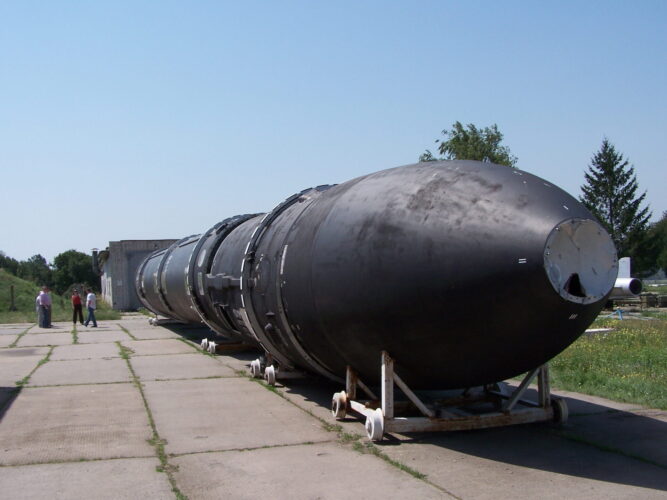
A decommissioned nuclear missile at Ukraine’s Strategic Rocket Museum (2010)
Nukes, ships and treaties
To sort out the nukes, in December 1994, Russia, the US and the UK signed the “Budapest Memorandum”. In exchange for Ukraine, Belarus and Kazakhstan giving up nuclear weapons on their territory, the signatories promised they would, I quote, “respect those countries’ independence and sovereignty within existing borders; refrain from the threat or the use of force against them; and refrain from using economic pressure on them to influence their policies”. Russia, the US and UK did not, however, commit themselves to offering military support to defend against any threat to the sovereignty of the three countries.
Three years later, on 28 May 1997, Ukraine and Russia signed “The Partition Treaty on the Status and Conditions of the Black Sea Fleet”, dividing the fleet and its armaments between them. Ukraine also agreed to lease naval facilities in Sevastopol, Crimea, to Russia for 20 years until 2017. This was extended in 2010 by Ukraine’s pro-Russian President Yanukovych to 2042. Ukraine also agreed to allow Russia to maintain up to 25,000 troops and related weaponry in the city.
Perhaps most important, on 31 May 1997, Ukraine and Russia signed the bilateral “Treaty on Friendship, Co-operation and Partnership”, also known as “The Big Treaty”. The treaty promised – this is key – the inviolability of existing borders and respect for territorial integrity, and committed each side not to invade the other’s country. You read it right: in 1997, Russia voluntarily signed up to treaties guaranteeing never to threaten or invade Ukraine, and recognising Ukraine’s 1991 borders – including Crimea. Putin broke both treaties in the first invasion of Ukraine in 2014.
Ukraine-Russia: What about the EU?
President Putin also likes to argue that he somehow had to invade Ukraine because of the EU. It’s worth remembering that Russia’s first invasion, in 2014, came after President Yanukovych of Ukraine, under Russian pressure, stopped Ukraine signing an “Association Agreement” with the EU. At that point, Moscow claimed they had not been consulted about Ukraine’s EU integration efforts; and that Brussels was being “provocative”. Shamefully, some western critics of the EU echoed these arguments.
In fact, from 1991 onwards, the EU held regular summits with Russia, including detailed briefings on Ukraine’s efforts to draw closer.
Russia never objected
Far from not being consulted, for 22 years from 1991 to 2013, Moscow never objected as the EU and Ukraine pursued practical steps to deepen integration. That process even continued under the pro-Russian Ukrainian President Viktor Yanukovych, elected in 2010. By November 2013, the EU was ready to sign an Association Agreement. So was Yanukovych. Russia up to this point had always been relaxed about the whole process.
How relaxed was Putin? Well, I visited Moscow, as British Ambassador to Kyiv, in 2009. I was intrigued that Russia was so laidback about Ukraine’s cosying up to the EU, which conflicted with Russia’s efforts to build its own Kremlin-dominated “Customs Union” with other former Soviet states. I called on the head of Russia’s Ukraine department in the Ministry of Foreign Affairs and asked him if Russia minded Ukraine getting closer to the EU. ‘Not at all,’ he said. ‘Of course we would rather they joined our Customs Union, but it’s up to them.’
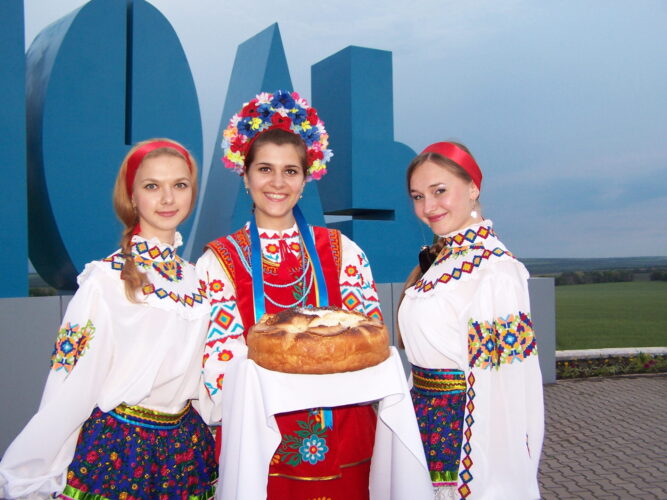
Greeting a delegation of EU ambassadors to Mariupol in 2010
What changed Putin’s mind?
Then, in 2013, three years after pro-Russian President, Yanukovych was elected and had been pursuing EU integration, Moscow did an abrupt policy U-turn. Putin told Yanukovych not to sign the Association Agreement. This was a key moment leading to Russia’s war on Ukraine. Why?
What changed everything was events inside Russia. In 2011-2013, large-scale pro-democracy demonstrations erupted in Moscow and other cities following alleged electoral fraud: the so-called “Bolotnaya protests”. The unrest convinced Putin he faced a threat from democracy washing over from a successful, democratic Ukraine. Under Putin, Russia has, since 1999, become an autocratic state, without genuine opposition parties or free media. Russians who oppose Putin, however peacefully, tend to end up dead. The Bolotnaya protests of 2011-13 convinced Putin that democracy, if left unchecked on the territory of the former Soviet Union, could sweep him away.
Ukraine-Russia: What Putin really fears
Thus, the real threat Putin correctly perceives from Kyiv is that a strong and successful Ukraine, if it were allowed to develop, could introduce the bacillus of democracy into the Russian body politic. That prospect terrifies him. Vladimir Putin invaded Ukraine to keep himself in power. It’s as simple as that.
It was after the Bolotnaya protests that Putin blocked President Yanukovych signing the Association Agreement with the EU in 2013. That in turn precipitated the “Maidan” protests in Kyiv, leading to Yanukovych fleeing the country. Russia seized the moment to invade Crimea and eastern Ukraine. But Putin’s policy backfired, creating a more, rather than less, pro-western Ukraine. Yuval Noah Harari argued in 2025 that Ukraine had already won the war because Putin’s invasion had turbocharged its sense of nationhood.
Russia faces its own crises
Up to 2013, before invading Ukraine, Russia was doing well economically. But since then, it has faced a series of crises. Leaving aside military and economic problems, Russia faces a demographic crisis, with a shrinking, ageing population. Even before the 2022 invasion, UN forecasts predicted that Russia’s population could fall from around 146m in 2017 to as little as 74m by 2100 – even including inward migration from Central Asia, where populations would grow. The war, and emigration of young Russians to escape conscription, has probably made things worse.
The war is damaging Russia’s relations with the rest of the Former Soviet Union
Russia’s links with the rest of the FSU are also in a bad place. The ethnic makeup of all these countries has changed. In Kazakhstan, Russians outnumbered Kazakhs as recently as 1979. Now Kazakhs outnumber Russians four to one.
Nearly all countries of the FSU are loosening their ties to Russia. China and Turkey have boosted links with countries in the South Caucasus and Central Asia such as Uzbekistan, Kazakhstan and Azerbaijan. When I visited Nazarbayev University in the Kazakh capital Astana in 2012, the language of instruction was English. In 2014 the National Museum of Kazakhstan, with its giant mechanical eagle in the entrance, contained no reference to the Soviet Union at all.
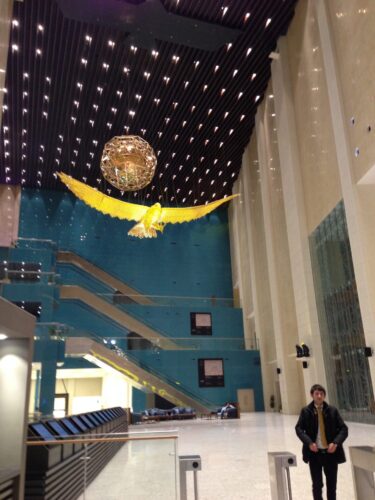
The National Museum of Kazakhstan, in Astana
President Tokayev speaks
Since Russia’s 2022 invasion of Ukraine, Kazakh President Tokayev, formerly an ally of Putin, has refused to recognise the fake Russian “referendums” held in occupied zones of Ukraine and has said Kazakhstan upholds the inviolability of international borders. In July 2026 Tokayev publicly told Putin that the war should be “frozen” and that he could not understand the reasons for it. This is not surprising, given that Russia and Kazakhstan have the world’s longest continuous land boundary at 4,750 miles. Tokayev knows that if Putin wins his war against Ukraine, Kazakhstan may be next.
Even the Cyrillic script has been abandoned by Moldova (1989); Azerbaijan (2001); Uzbekistan (2023, ongoing); Turkmenistan (1991, 1999) and Kazakhstan (2017, ongoing). These independent countries see ditching Cyrillic as a step towards decolonisation. Only Kyrgyzstan, Tajikistan and Belarus have no plans to change at present. Ukraine, Armenia and Georgia have their own scripts.
None of this, again, is the result of a plot by anyone. Rather, it is peoples from the former Russian empire choosing their own paths.
Ukraine-Russia: prospects for peace?
So if that’s the historical background, what are the prospects for peace? Sadly, at no time since 2014 has the likelihood of a negotiated outcome looked anything other than bleak. In 2022, after Russia’s full-scale invasion, Ukraine suggested a ceasefire and talks based on the pre-February 2022 boundaries. Talks ground to a halt amidst deadlock over security guarantees. But the suffering caused by Russia’s invasion since then has hardened positions.
Ukraine doesn’t want any agreement that in effect rewards Russia for invading it by transferring sovereignty over land. On the Russian side, Putin doesn’t want to agree to anything that leaves his troops occupying no more of Ukraine than they did in February 2022. How could he justify to the Russian people the chaos and destruction he has wrought – including over a million Russian soldiers dead and wounded – for no gain? That would surely be the end of his rule – the very outcome he launched his war against Ukraine to prevent. For Putin, the war is existential.
Unfortunately, a grinding war of attrition continues to look the likeliest medium-term outcome unless one side or the other suddenly collapses. Russia will try to seize more land. Ukraine will try to resist, and maybe push forward if they can do so without suffering high casualties. Despite recent Ukrainian successes, the war is far from “won” for either side.
Might one side or other collapse?
Ukraine is under immense pressure. Russian attacks on civilian infrastructure have continued for years, including enormous waves of drones and cruise missiles and ballistic missiles to which Ukraine, as yet, has no answer. Ukraine is suffering manpower shortages on the front line, economic pressure and resistance to conscription. President Zelensky faces problems of democracy, such as pressure to tackle corruption and debates over politics and appointments that Putin, as an autocrat, does not have to deal with. On the plus side, Ukraine has immense determination and motivation, and extraordinary innovation.
Russia, too, is struggling. Every decision Putin has made since 2013 has been wrong. He has turned Ukraine, a friendly neighbour, into a bitter foe. His actions have caused Finland and Sweden to join NATO: Sweden was neutral for over 200 years before that. The war has turned previously sympathetic countries such as Germany into enemies. Russia, too, has severe shortages of frontline manpower; and materiel – and for those soldiers they have, motivation is a problem.
Putin knows Russia is unstable
Putin has spent years building a system where he is difficult to overthrow. But the longer the war goes on with minimal results, and the more the war affects people inside Russia, the more vulnerable he is. We’ve seen a wave of dissent in Russia over internet blackouts, rising fuel prices and the visibility of Ukrainian attacks.
The situation is unpredictable. The June 2023 mutiny by the forces of mercenary leader and Putin ally Yevgeny Prigozhin, who stated publicly that the reasons given for the invasion of Ukraine were lies, showed how quickly the situation could change. This was the third putsch against Moscow in recent decades, including that in 1991 against Gorbachev and the 1993 uprising against President Yeltsin. Putin tries to present Russia as implacable and indomitable. But the supposed stability of Russia is a Potemkin village.
European policy on Ukraine: under pressure
Putin hopes that a long war will sap the collective will of countries supporting Ukraine. Up to now, the opposite has happened. Each time evidence of Russian atrocities has emerged, such as mass graves or attacks on civilians, the resolve of Ukraine’s allies has grown. But maintaining political cohesion amongst allies to support Ukraine financially and militarily in the long term is a challenge. All Ukraine’s supporters have their own economic and political problems to deal with: fresh crises are constantly erupting.
In Europe Germany, under Chancellor Merz, is playing a central role. But the rise of the AfD is troubling. France and the UK seem mired in near-permanent political crises. In the UK, convincing UK voters to accept tax rises to boost defence spending long term won’t be easy – I wish Andy Burnham good luck with it. The Baltics, Scandinavians and Poles are boosting spending but they can’t do it alone. Countries further away – notably Spain – still seem to be trying to pretend that this war doesn’t really affect them. Recent reports that the EU is having trouble agreeing on sanctions because of special pleading from numerous member states show how difficult things could get.
US policy on Ukraine-Russia
The US remains an enigma. Since he took office in January 2025, President Trump has consistently adopted a bafflingly pro-Russian line. In February 2025, President Trump called President Zelensky of Ukraine a dictator. The same month, the US refused to condemn Russia for invading Ukraine at the UN – and we saw that extraordinary argument between Trump (backed up by J D Vance) and Zelensky in the Oval Office. Twice in 2025, the US cut off arms to Ukraine and has now more or less done so again.
It isn’t clear that Europe can rely on the US either for long-term military and economic support to Ukraine, or for the kind of pressure on Russia necessary to bring Moscow to the negotiating table. There are lots of things the US could do. One would be tougher “secondary sanctions” on Russia – eg penalising countries that buy Russian oil. The other would be to provide major, high-profile arms to Ukraine.
On sanctions, during 2025 there were many examples of Trump expressing frustration with Putin. On 30 March, Trump said he was “pissed off” and “disappointed” with Putin. In April, after meeting President Zelensky at the Pope’s funeral, Trump accused Putin of “tapping him along” and threatened banking or secondary sanctions. In July Trump said: “We get a lot of bullshit thrown at us by Putin. He’s very nice all the time but it turns out to be meaningless.” In none of these cases did consequences follow. Instead, in August 2025, Trump treated Putin royally at the Alaska Summit, and made strongly pro-Russian comments.
US arms supplies to Ukraine have also proved elusive. In July 2025, President Trump said he would “massively supply Ukraine with what is necessary” through NATO. Including Patriot air defence systems. There was discussion of longer-range offensive weapons such as Tomahawk cruise missiles. Such equipment could make a real difference in a finely-balanced, grinding war of attrition. But US support so far remains half-hearted at best.
Is US policy evolving?
We have recently seen a couple of changes in US positions. In July 2026 Laura Loomer, a US influencer, long-time critic of Kyiv and close ally of President Trump’s MAGA (“Make America Great Again”) movement, visited Ukraine. It resulted in a complete shift in her opinions to favour Ukraine, as evidenced in this AP interview. A longer interview, with a Ukrainian journalist, is here. Loomer describes Russian efforts to manipulate US public opinion and expresses support for Ukraine. President Trump also had warm words for President Zelensky when they met at the NATO Summit in July 2026. He even offered to let Ukraine manufacture Patriot missiles under licence. Whether Loomer’s shift in views and Trump’s new warmth amount to a change of policy, however, is not yet clear.
Or could US policy on Ukraine get worse?
Throughout 2025 and early 2026 worse outcomes have loomed. Mr Steve Witkoff, Trump’s envoy, met Vladimir Putin and came away repeating verbatim Russian talking points. Witkoff set out his views at length in an interview with US journalist Tucker Carlson on 21 March 2025. It’s a tough listen. During 2025 President Trump consistently put pressure on President Zelensky to reach a settlement that included making big concessions to Russia. Reports in early 2026 suggested the US was pressuring Ukraine to give up additional land in return for security guarantees. That land included territory Russia had been unable to take in 12 years of war.
If the US continued down that path, we could end up with a so-called peace deal on terms very disadvantageous to Ukraine. This would in effect mean Russia winning the war. That would be a catastrophe for the security of Western Europe including the UK, as well as for US security. I’ll explain why in a moment.
So what should we be doing?
Against this background, the UK & Europe need to do two things.
First, we need to continue to work on securing political, economic and military support from the United States. This is pretty hard pounding. We saw this at the June 2025 NATO Summit. Basically, other NATO members fought to get President Trump on board for a reasonably positive joint statement. The same happened at the 2026 NATO Summit. Again, results were quite good.
Why is it so vital that such work continues? It is because if Russia wins this war, the world will be a much more dangerous place, including for the US itself. Not only will Russia be emboldened, more dangerous and aggressive. Every other country around the world that fancies taking a bit of its neighbour will be encouraged. The non-proliferation treaty that prevents the spread of nuclear weapons will be screwed.
Nuclear nightmare
I mentioned earlier Ukraine’s abandonment of nuclear weapons under the Budapest Memorandum in 1994. Moscow’s invasion – a nuclear-armed country invading one without nuclear weapons and threatening to use those weapons if the country tries to defend itself – broadcasts a message to countries worldwide. Unless you have nuclear weapons, a nuclear-armed country can invade you any time it wants. Such a weakening of the nuclear non-proliferation infrastructure would be a disaster for global security, including for the US.
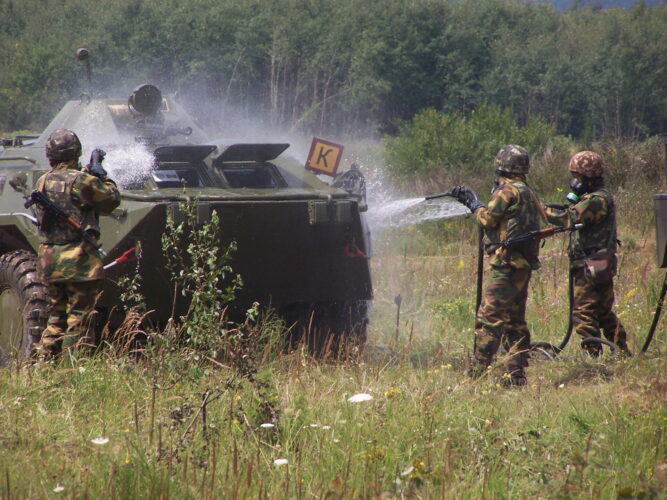
A military exercise in Ukraine, 2011
The US above all should see this. But we can’t depend on it. President Trump is beyond mercurial. The point on which he has been most consistent is in trying to convince us we can’t rely on him. We should listen.
This means that the second thing the UK and the rest of Europe need to do is to step up and continue, if necessary, to help Ukraine resist Russia even without the help, or certainly without the wholehearted help, of the US. This will be a colossal undertaking. It will require European countries, including the UK, to make the political case to their electorates that this war is about their security. If we’re talking about a diplomatic solution to this war, this is the only diplomatic move I see that stands a reasonable chance of success: trying to keep the pro-Ukraine alliance together. Otherwise, Ukraine could be forced into a catastrophic surrender.
I would also support calls for stepping up the information effort. The reason Russia’s information war is so successful is that they view the war as an existential challenge. We need to realise: it’s existential for us, too.
Ukraine can win this war
Can Ukraine win this war if we step up our support? We’ve seen quite a turn-around over the last six months as Ukraine has increased its short-range, medium-range and long-range drone attacks on Russia. Even with limited support from the US and Europe to Ukraine, Russia is struggling. If the UK, France and other European NATO members and Canada, can make the kind of investments Germany has announced – essentially, to re-arm to resist Russia – Ukraine can win. But for that, we need to convince people in the UK, the rest of Europe and ideally the US, that the alternative – to allow Russia to win this war – is so dangerous for all of us – not just Ukraine but Europe and the world as a whole – that it should be unthinkable.